11 things that Social Media is not

I was ready to tell Geoff Livingston what social media wasn’t and then I had an acid flashback and I started ranting about something else completely unrelated. he was still waiting as of this post. Well. it’s not the first time, I left someone hanging or wandered off track. I’ll be lucky if I can keep this on point.

Thanks in part to Scoble we know that Social Media is not:

  • Newspapers.
  • Magazines.
  • Television.
  • Radio.
  • Books.
  • CDs.
  • DVDs.
  • A box of photos.
  • Physical, paper mail and catalogs.
  • Yellow Pages.

But we all spend so much time explaining to each other and anyone willing to listen, what social media is, perhaps if we turn it around and tell people what it is not, then maybe that will help define it better. If anything, it will be a fun excersise in twisting everyone’s interpretation of what it is. So here are 11 more.

1-Social media is not about the above mentioned entities now being able to talk with us. It’s not about mass media. It’s more about the audience finding it’s voice.  Hell, those guys, the old school, they are some of the most resistant adopters of anything that remotely resembles social media. They are stuck in their one to many, cul-de-sac marketing ways.

Brainstorm: Cul-de-sac marketing-The marketing efforts go in the same way as they come out with exhaust fumes in their vapor trail, and within that trail are the buyers of their  marketing elixir. Their schtick.

2-Social media is not up to them, it is up to you and your voice

3-Social media depends on but is not predicated on many to many, and 4-is not one to one, but it can be. But it certainly is better than one to one and wait. It’s one to one, realtime. 5-Social media is not closed to anyone. It’s blind to race, creed and color, social status etc. All it cares about is your ability to communicate. The rest, the particulars, have a way of sorting themselves out.  6-Social media is not calm, sedate, unresponsive, or static. It disprupts. It’s in your face. 7-Social media is not passive. 8-Social media is not laryngitis. 9-Social media is not just for kids. It’s for Gen X, Gen Y, Gen C, and the Boomers. 10-Social media is not mainstream, yet. And finally, thanks Brian Solis 11-Social media is not the final frontier of marketing

Please feel free to add to the list of what social media is not. I could only come up with 11 thus far. Hook me up.


Chasing the dragon that is social media

Social media…….social media…. I was reading Geoff Livingston’s latest post and he had a clip on there from Tech Cocktail in which he, David Armano, Frank Gruber and Danielle Wiley opened with a “what is social media” intro.. Which got me wondering, ranting, or just pondering first a) am I too close to the subject and b) c) d) e) and f) and g) are below…

This is what I wrote to Geoff..

Let’s talk about what social media is not. In fact, what if the term social media was banned from our lexicon, what would we call it then? Is it an accurate term to use? Have we trounced on it too much? Or is it still this mystical nirvana like state that marketers, advertisers, agencies, and corporations are all chasing? Are they chasing the dragon? Are we forcing them to chase the dragon? Is it elusive? Are we making it that way? Can we dumb it down? Does it need to be?


It’s not really a rant per se, more of just “lots more questions” from maybe a different point of view. Some might say that social media is merely the flavor of the moment for marketers and PR people. Uhh no, it’s where we are headed, and we can choose to integrate and embolden and implement or we can get steamrolled by the ones who decided to embrace it from the get-go.  Who is the person that said “a computer in every home will never happen, it just doesn’t make sense…” Who would like to step up and say, social media is nothing but another internet phase…a fancy web based app…go ahead and throw the first stone.

 Here’s a link to the Vid

What is our personal saturation level for social media?

Could there be a point down the road where we all just get burned out on whichever social network we are a part of? Doing a search on any posts that point to or mention social media saturation brings up very little, with the exception of the aformentioned link by Illuminea. With that being said, Jeff Nolan in his blog noted that We now log an average of 9.7 hours each day consuming media. Some experts say we’re at the saturation point. Interestingly enough, he mentioned that in August of 2007! One year removed almost, I would have to say that that number has definitely increased. There are close to 2000 social networks, its growing by the day, microblogging is coming on hard and our mobile devices are now like an extra appendage!

So 9.7 hous per day covers media in general, not neccessarily social media but all media.  Because there are so many forms of media that we as a public devour, I don’t think we’ll ever get to the point where we all sit around and toss in the towel and say, That’s it, I’m saturated. I’m done with my Ipod, my laptop, my cell phone and the television and movies. Hell,  we could get finite and include, newspapers, magazines, kindles, and tin cans with strings, but I digress.

You see, here’s the thing. Jude Yew talked about how managing 13,000 friends might get difficult, but when does it just become a pain in the ass to manage x amount of SNS’s (social networking sites) and x amount of profiles and x amount of friends. When does it cease to be fun? When does it cease to be about Networking for the benefit of your business?  Case in point, there’s a guy on LinkedIn and Ning for instance whom I won’t name who links and networks with whatever is moving. It smells like an MLM but my point is it’s no longer networking it’s something else. Perhaps its his way to build a database with the guise of “Linking” I don’t know. But if thats what happens or is happening then networking and linking to people all of a sudden become water downed.  As Yew further writes:

I think that this brings up an interesting issue with how poorly the PR/Marketing/advertising industry understands how Social Networking sites work. We’ve seen the large migration of teen users from sites like friendster and myspace to facebook in the past year. One of the oft cited reasons was that the teens were tired of being hounded, not just by fake profiles (which is also a PR/marketing type issue), but by advertisers.

At one point in time I used to have a MySpace account but after being hit up by every hooker like name that ever existed,i.e. Domino, Ashley, Sindy, and Nicole, I decided that I didn’t need “that” type of friend. So I bailed.  But, what if every SNS begins to buckle under the pressure of letting advertisers trying to link and network and make friends with its database of actual users?

2 things happen. Real actual users are going to leave in droves and real actual users are going to be wary of any subsequent social network they join. Amazingly enough, isn’t that what is occuring now? Everyone is a member of anywhere from 2 to 5 social networks? Why? Because one is bullshit or turned into just a jive network, whereas another delivers x but not Y. So we use them until more come along and we use them and we may or may not discard the old ones and before you know it, we’re saturated.

So now what? How do we manage our profiles and our memberships and keep it at a palatable level? Or even better, how many of you just abandon that profile or membership without deleting the information? I’d bet, depending on your age, that most of you don’t bother. The worlds advertisers thank you.

So what will happen to all things social network related when we do reach our saturation level? What is everyone’s personal saturation level? Let’s see if we can come up with some type of formula shall we? I’ve posed the question to some members of the Linkedin community, I will follow up with another post on those answers.

13 more green/socially conscious social networks worth noting!

In an effort to keep building momentum so that we can sustain ourselves without being so dependant on others, but also so that we can help those who cannot help themselves, I give you 13 more green, socially conscious social networks. With that being said, I think the more you, we, me, pay forward what we can, the more you get back. Especially if you are not looking to receive anything in return.  I welcome any additions to this list. But I also think it’s important that we all actually look at the list of sites and see where we might be able to contribute.  If that doesn’t float your boat then at least share this list with someone else. I want to give a shout out to Earth2Tech for getting the ball rolling.

http://www.edenbee.com

http://www.people4earth.net

http://www.onebuckfortheplanet.org

http://www.hugg.com/

http://www.justmeans.com/

http://www.SaveYourWorld.com

http://www.unltdworld.com

http://www.dothegreenthing.com

http://greenandcleanmoms.ning.com/

http://www.greeniacs.com

http://www.gaia.com

http://www.wecansolveit.org

http://www.MindBodyGreen.com


Traditional Media is afraid of Web 2.0

Jake McKee promised that this might be the most significant thing I see/read/watch this year. In a sense he’s right. I love when people make me think. Clay Shirky made me think. And what he says makes sense. You might have to watch it twice but what I take away from it and told Jake essentially the same thing, are three things. 1) traditional media is scared shitless about what is happening right now. Consumers with voices? And the ability to use them? 2) We all have a surplusof cognitive surplus and 3) The old, one voice marketing to many with traditional channels of one way communication are dying on the vine.

10 random social media facts, lists and questions I have for our web 2.0 world


According to Aaron Barnes , In 2006 the total marketing spend on social media was $350 million, the forecast spend for 2011 is more than $2.5 billion. A couple of thoughts cross my mind. 1-who is spending the money now and is the spend worth it right now given the fact that a lot of marketers are still feeling their way around in the dark. 2– by 2011, How many social networks will there be? 3– How much of that projected budget will go towards social nets that exist today?

4-I had heard that there were currently 850 social networks and that within the next 2 years we might see upwards of 250,00!  5-Do you believe that?

With that being said check out some interesting stats from september according to emarketer

The most widely used social media strategy used by US businesses was Blogs for editorial staff at 78% of total respondents. Check out the following in order of use:

Discussion Boards 76%

RSS 57%

Ratings and Reviews of articles or site content 47%

Profiles of Social Networking 45%

Photo Albums 39%

Chat 35%

Personal blogs 33%

Video-user submitted 35%

Podcasts 33%

Social Bookmarking 29%

Video Blogs 29%

Widgets(deployed on FB, Myspace and Google) 22%

Mobile Video/image text submission 16%

Wikis 16%

Citizen Journalism 12%

Micro-blogging (twitter, Jaiku) 6%

Virtual Worlds 4%

Other 8%

Couple of questions: 6-What constitutes other at 8%? and since this was done in September, 7-How much and in what directions do you think those numbers have moved for each that is mentioned? I have some thoughts but am always curious as to what other think. BTW, 8-How many of you do use what is mentioned? 9-How many of the list do you still use daily?, and 10-How much is for business use as they, say and how much is for personal use?

What will be social media’s tipping point?

Malcom Gladwell defines a tipping point as a sociological term, “the moment of critical mass, the threshold, the boiling point. Tipping points are “the levels at which the momentum for change becomes unstoppable.” Joe Marchese said back in October that:

 As advertisers and agencies rely ever increasingly on individuals to pass along their marketing message, the advertising and marketing messages themselves must now achieve their own tipping points within the social media communities in order for marketing and advertising to continue to be an effective tool for brand advertisers.

Ok I get that. Perhaps advertisers and marketers have reached the tipping point in regards to how they are reaching the users of social networks, but ultimately I think they haven’t reached that point. I think the conversations that abound right now are of a substance that says, this is the conversation, do you know how to join it? Do you know how to leverage it? Are you aware of how it works? Do you get that the conversation does not start with your brand, it starts with the people that dig your brand?

As a marketer, you need to listen before you speak.

The answer for me is that no, marketers, and branders do not completely “Get it”. Thus the need for the social media evangelists, the brand evangelists, and the Seth Godins of the world to dumb it down for us and for them.  Why do they have to dumb it down? Because we, they, us, just cannot completely wrap our hands, our arms, our minds, arounud the monolithic beast that is the social networking phenomenon. There are a lot of moving parts. And I find myself daily explaining “it” to n00bs and people who actually know more than they let on.

For a marketer using social newtorks, a tipping point could be construed as a viral effect or a WOMM effect in which they can virtually sit back and watch the machine roll. To them, it means they have done their job, or so they think. To truly engage the user and the customer to use them as their champions is to create a conversation that breeds success beyond their wildest dreams. Because they have created buy-in on an exponential level.

Problem is, it has not happened often enough. And though it can be duplicated, and replicated, the moving parts, the variables, and the uncertainty of a social networks eco-system dictate that it will change and evolve and be ruled by the members and factors that you can never account for and not the marketers. But what happens AFTER a tipping point for a marketer in a social network setting? What is the life expectancy of the product, the user, the marketer, and the network? Can anyone provide me a case study for the “aftermath” of a tipping point for the aformentioned in a social network setting?

Has it happened yet? I doubt it. What’s intriguing is that in Geoff Livingston’s   blog in which he has a weekly round up called Blogs of fire, author Marinel Mones linked to Nick O’Neill of Social Times in which he states that social networking sites will die in two years. Does that mean SN’s will have flamed out, reached their tipping points and then crash and burned? Do we just move on? I dare to say we don’t and that saying something as ambitious as SN’s will die in 2 years is more of an attempt to grab some eyeballs than anything else. What do you think? I believe I asked a number of people in the 20 million strong soon to be dead  in 2 years Linkedin network where they thought social media and networks would be in 5 years and the answers were varied and deep and thoughtfull and none approached the answer of Nick O’Neill.

Do I think Social Networks will approach some type of tipping point? Yes, we will reach  some type of saturation point, but I don’t think we have yet, much to the consternation of Daniel Riveong, but much has changed in the 2 years since he wrote that it had already started to happen.

The saturation point might just be a case or situation where out personal saturation point will be determined by what we can manage and not neccessarily a case of too many choices. But…invariably our choices are determined by our friends, our niches, our desires, and huh? Marketers? and so it has now come full circle…

In conclusion I pull an excerpt from the NY Times in which Duncan Watts writes about culture, Hollywood and Justin Timberlake. Check out the sublte social networking undertone to this statement.

The common-sense view, however, makes a big assumption: that when people make decisions about what they like, they do so independently of one another. But people almost never make decisions independently — in part because the world abounds with so many choices that we have little hope of ever finding what we want on our own; in part because we are never really sure what we want anyway; and in part because what we often want is not so much to experience the “best” of everything as it is to experience the same things as other people and thereby also experience the benefits of sharing.

So 2 questions that I will continue to explore:

What is social medias tipping point?

and..

What is our own personal saturation level for social media?

 

Monetizing Social Networks. The simplest analogy possible!

Aside from the big players in social media making money via advertisers and cutting deals with some of technologies biggest hitters, there are more social sites that do not make money then there are those that do. What do they do? How are they going to make money?

Obviously one of the ways to create a social networking site that actually makes money is to niche-ify it to the extent that is speaks to a specific type of brand user and all the products or services that can be wrapped around the user. Picture the hot dog . Thats right, you are the hot dog. Your social network, the hot dog. You are going to be interested in all things related to you. 

Now the hot dog has the bun, the ketchup, the mustard, the relish,and the onions. All viable participants in the network. Including our friends chil and cheese. Couple with that will be napkins,  something cold to drink and perhaps to go with the hot dog, a side of chips.

All of these mentioned make perfect sense. They are viable, channel driven, niche driven, complimentary, cross promotional products that speak to the center of the social network universe known as is…the hot dog,

The problems arise when something that is totally irrelevant tries to crash the party. And interestingly enough, you would be surprised how often the following happens:

The best example of a lot of people trying to crash the party is perhaps the frenzy that is Myspace and Facebook. The frenzy of advertisers wanting to take advantage of million and millions of customers waiting(or are they?) to be pitched. Problems can arise from people who try and crash a party that they’re not invited to. Some great examples can be found in Jeremiah Owyangs post on brands that got punked by social media

As an advertiser, one just needs to know and it’s not like it’s that difficult. Are you the windshield, are you the bug? Are you the louisville slugger, are you the ball? Are you the hot dog? are you the bun? Or are you window cleaner that is the upsell to a box of triscuits?

10 Green Social Networks

Just because we’re in tech doesn’t mean that we can’t do our part to try and push for a greener space. Here is a great post on 10 green social networks that you need to know about.,

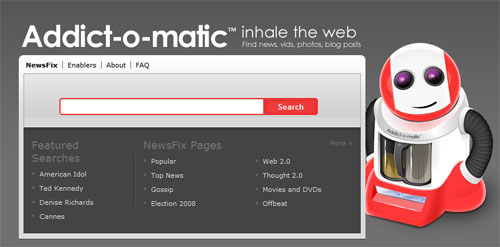
Addict-o-matic

I saw this Addictomatic on Rohit Bhargava’s blog and it’s pretty cool..Dare I say, it’s addicting? Thanks Rohit for sharing. Great interface btw…