What happened to the Ah-Ha moment?

Do you remember the first time you got a blog comment? Or the first time someone followed you on Twitter. Pretty cool wasn’t it? All of a sudden this static world of reading and consumming media changed-overnight. All of a sudden we all had voices.

I remember the first time I connected with an old friend on Facebook. It immediately showed me the power of the platform and it’s infinite possibilities. Which naturally lead to these thoughts- “I can’t beleieve they found me”, “Wow do they look old” and “I wonder who else is on here”? I truly believe it was those 3 thoughts that fueled the desire for more from users who both created and consumed Facebook content. It was like crack.

Depending on your background and skillsets, the early days of social media for a lot of us, were so wonderous and so filled with curiosity. Connecting with new people who were your peers, and then having these really deep discussions through blog posts and comments or tweets on Twitter, took the power of social media for us and elevated it.

We blogged about it. We waxed poetic about it. We told whoever was listening about it, and even those who might not have been listening, how cool and powerful this thing called social media was. We were all evangelists who had Ah-ha moments.

But something has happened. The Ah-Ha moments are diminishing.

Do you remember when the internet first exploded on the scene? How everyone was enamored of it? Or how about when the iPod came along? Do you remember the cool commercials and the desire to have one, how great it was? Is it still like that? It’s not, is it? Why?

The problem?  Mass consumption and the expectations of consuming as it relates to creating.

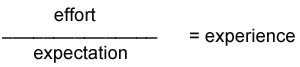
Like any addiction, as you continue to consume, it takes more and more effort to satisfy the craving.  In social media your magical moments were created by you, but moreso by your connections. It’s just they were driven to you inversely by your effort.

We want more Ah-Ha moments but…they are just few and far between now. You’re probably thinking well a sage veteran already had their moments, it’s only for the newbies…Really? Is that the way it supposed to be? Can’t we have more?

In the “social media” beginning, your effort to have conversations equaled  a great experience because the expectations were so low and there just weren’t a lot of people in the space.

But as social media has evolved and Facebook now has it’s 500 millionth user,  the web 2.0 experience has changed what we think, what we know, and how we use it. Our experiences have been dulled and our desire for new and shiny has increased, all because of us. Why us? Because the tools and platforms that make up social media, have allowed us to create and  experience things at levels that would have blown our minds 3 years ago. Demand is way up, experiences are way down and expectations have never been higher.

Our social media experiences are just that. They are merely experiences now. Our expectations are getting so high that we’re likely to be disappointed by our experience. I worry that our expectations keep rising not only in waiting for the next big thing, or the next great connection, or great business deal, but also for the type of content we consume. Why? It creates the  false assumption amongst creators of content, that what will please us needs to constantly be elevated.

A more potent solution.  Bigger, better, faster.

Funny thing is, what really has driven growth and adoption, more than anything else-hasn’t been technology, though it has helped, it’s been about the human element. It has been about the Ah-ha moment.

It’s always been about you, me and them. We are responsible for our Ah-ha moments. They are there. We can have them anytime we want.

Should Your Social Networks Mingle?

A lot of the apps and web services that come across the desk lately have to do with consolidation and aggregation. In fact, back in April there was a pretty good post in Social Media Today on 7 social media aggregation tools that you should use that caught my eye. I went through the list and I was familiar with 4 of them. But there’s a larger point I want to make here.

Actually 2 points.

Point #1. I’m going to use Yoono as my first example. Yoono connects you to your social networks and messengers. It unifies your status updates into a single stream of information and lets you update your status across all your social networks at once. Social media sites that are currently supported include, Facebook, Twitter, MySpace, LinkedIn, FriendFeed and Flickr. Messenger services are available through Google Talk, AIM, Live Messenger and Yahoo Messenger.

But what if each network has specific audiences? i.e. Facebook is family and friends. Twitter is your peer network. Linkedin is a business networking network and Live Messenger is say for your customers or something like that. My networks are somewhat broken out like that. I don’t want them to overlap. I don’t want my Facebook friends to receive my Twitter updates. I don’t want to pollute, so to speak, my otherwise “clean” Linkedin network with my Twitter updates. Occasionally I add the #li hashtag to a tweet, but otherwise I keep them separate.

You might be asking why I keep them autonomous but my simplest of reasons is that my networks are not all “business” related and conversely not all are intimate and or personal. Consider it strategic but it works for me. Different networks, different messages.

Point #2.  There’s an assumption that we need consolidation and aggregation. I would say yes and no. I definitely think that having universal logins is heading in the right direction but there is one issue that I have with that. Profiles matter but they almost have to be a bit different for each network. People sometimes need to push out a different yet more effective profile per each network. Linkedin vs. Twitter vs. Facebook vs. Myspace. Different niches, different networks, different profiles.

Consolidation yes aggregation maybe.

More and more we are becoming members of more networks. That won’t be changing. I’m not sure there is an answer for posting updates that populate across all networks in which your networks understand the meaning. I may be looking at this too hard from a business standpoint and that’s OK. But the bigger picture is that consolidating our social networking effort is what we all want because we’re all hell bent on laziness or efficiency-take your pick. It’s just that  aggregating or mingling them with any type of contextual adaptive effectiveness might be trickier.

If You Could Use Only One Social Media Solution, Which Would It Be?

Given that most of us claim to be too busy to do anything anymore-and it is somewhat true. Traipsing in and bellowing to anyone who will listen, that the tranformative nature of social media will change the way you do business for the better, is a lofty claim.

Let’s do a hypothetical. What if you could only use one “social solution”? Which would you use? and why would you use it? Let’s say you’re a consultant, which social media solution would you suggest and why? Which one is going to have the largest impact on your company? On your business? For your client? What if you’re boss said, “Pick one”, and given that that’s  a minor miracle he said that-which will give you the firm footing to do more later on down the line? The most impact? Results?

This is kind of important for a number of reasons-not the least of being that some solutions are just not a good fit for some types of organizations.  The reasons could be limited resources, limited time, money or whatever-but you just don’t go and jam a generic social solution into every company just because they want one. You’re going to set yourself up to fail if you do that.

Just because a company can set up a Facebook fan page for example- does that mean that it will give them the biggest bang for their efforts? Maybe, maybe not. What is going to give them the biggest return, the biggest impact? You can only choose one.

Let’s short list 11 high level social media solutions and tools right now.

Each of the above have specific bells and whistles that allow you to do certain things.  Remind me again, what’s the goal of social media? To have conversations? To sell stuff? To grow the business? To enrich Customer service? HR? Competitive intelligence? PR? Collaboration? Which one could do all of those?  I got a better idea. Maybe you should just concentrate on one  specific social “thing” that will make your organization better?

Ahhhh haaaaa…  That’s it! Which one can do one thing that can make your organization better at what they do? You don’t need to try or “do” every social media solution to be successful. Just one-Doing one thing really, really well, will work.

The “other” types of social media users

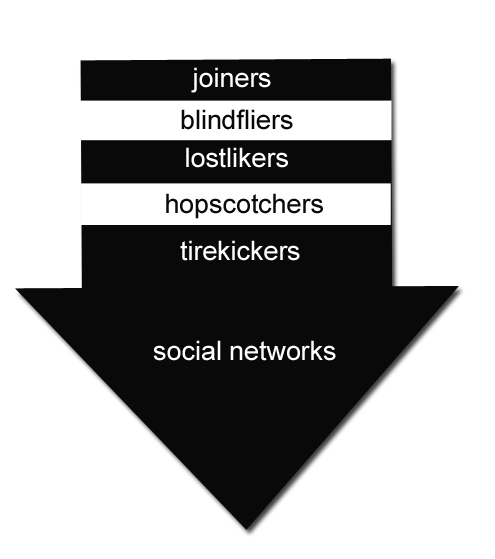
This is such a transcendent time isn’t it? I’ve been thinking a lot about how people use social networks and why. We have talked a lot about digital natives, immigrants, early adopters, lurkers and what not, but there is another group I’ve been tinkering with that I can easily add to the mix.

Joiners

The newbie in social media might think, and somewhat accurately I might add, that it’s easy to just dive right into social and worry about the big stuff later. True, you can, but I like to categorize those people as the one’s who leap before looking. They’ll join any and all social networks that they can. By the time they stop to worry about the little things, there will be bigger stuff on top of the big stuff and they’ll gravitate towards that.

Blindfliers

Then there are those that might look before leaping but don’t really know where they are landing. They are flying blind into social media. They’re excited. They’re not even taking the time to learn, but that’s not really a concern. They’re just happy to be here. They learned just enough to be dangerous. Like how to upload and share photos. They are a critical component to the success of social media-they will share the coolness of it all with others.

LostLikers

Some do manage to land after leaping but then they don’t know where they are. Those are the one’s who join a social network without really vetting the users of that group. It just seemed like a cool network to join; Or a cool tool to use, or a good idea at the time. They created a profile and started to interact before realizing that this group is not really for them. There are a lot of people that fall into this category. The good news? They liked their initial experience. Eventually there will be a tribe for all of them.

Hopscotchers

Still others leap and never land-To me those people are not really into it for the right reasons; they are the marketers, agencies, advertisers and companies that are trying to capitalize on all the buzz that they’re hearing. They will create a profile, add a link, and not much more; they’ll think that’s sufficient to get it done- -they’ll soon move on to the new shiny thing. Those people will shortly be touting how brilliant and cool Augmented Reality is.

Tirekickers

There is of course those that might land but they don’t really care if they do-they are the ones who will test drive, use the networks a bit and move on, declaring that social networks don’t work. They don’t give it a chance. They are not really engaging-or don’t understand the level of engagement needed to be successful. Those are the Tirekickers. They might be useful as beta testers and not much more. If they decided to stay around longer than a month.

What other types of users are there that I could add to this?

Social networks are redefining what a friend or a relationship really is

This is a post where I am right but so is Brian…

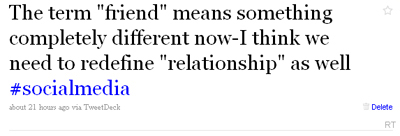
So yesterday I was talking via Twitter with Brian Dresher, the manager of  social media at USA Today. The discussion brought on by this tweet/thought:

Brian followed that thought up with mentioning that “following” someone pre-Twitter meant something more akin to stalking than it did to something more related to complimentary. You got that right.

There was a bit more to the conversation but here’s the point that I want to get across- and I’m fairly certain that you would agree with me. If you don’t, that’s OK, these thoughts are my own.

Like it or not, Social networking is redefining terms of “social endearment.”

It’s forever changing the etymology of commonly used words; and I would say easily within a few years it will completely alter their understanding and perception as younger generations continue to evolve as digitals’  new natives.

Here are the prime and most glaring examples.

  • Friend-Means absolutely nothing anymore. All it means is that we have allowed the other into our networks, or vice-versa. Soon we will have to qualify what kind of friend you or they actually are.
  • Follow-At its core, to follow would mean to come or go after; proceed behind; go in a straight or obvious course. There is nothing in the social networking world that resembles that definition. But as it stands now, if I were to tell you that I follow him or her-there still might be a pregnant pause. That too will soon change.
  • Like-I don’t even know where to begin.
  • Relationship-the definition of the relation connecting or binding participants in a relationship would seem to closely align itself with today’s social networks. However, some now think that relationships can be built on the thinnest of determinants. Which lead to this next tweet from me:

It took Brian’s next tweet to add the proper context to all of this.

He’s right. I didn’t know Brian before all this social networking “stuff” started and now we have a casual business relationship because of it. It has become enhanced because of it. We have met and talked at a conference, and later this summer he is going to host a Social Media Tweetchat for us. Thanks to the power of social networks.

Is there a fallout to all of this? No not really. We’re just adding layers to the complexity that is online communication.  In order to get to or take a relationship to the next level, They’ll still have to be consummated at some point offline. Right? Maybe not? Maybe these new layers allow for less physical/face to face interactions?

Maybe not.

*I know there were a ton of other “social” words that don’t mean the same thing as they used to that I did not mention. I’ll leave that up to you guys. Anyone want to start a wiki?

Social Media Marketing:Less of Big and more of Small

I jumped in on the weekly #brandchat discussion that was happening on Twitter yesterday to answer the following question:

What do small businesses need to be doing less of?

Great question. Here was my answer…

Less of Big and more of Small.

I got an “amen and a hallelujah for that tweet. What did I mean? Hold tight because I’m going to use a couple of baseball references again, but I will keep it short and simple.

The first is this. Did you know that baseball players get paid millions upon millions of dollars to fail seven out of ten times? That’s right. They generally have to hit the ball three times out of ten, and they are considered good at what they do. Why? Because it’s so damn hard to do.

We often overlook or I should say, most seem to think that implementing social media can be done by…

A monkey.

What ends up happening is that folks bail out after a month or so because talking to people, customers,  monitoring sites, creating consistent content, is hard and it’s labor intensive. You have to really work at it and be diligent. Sorta like hitting a baseball.

Not everyone can hit .300.

Funny thing is, baseball players who do hit the ball 3 out of 10 times, work very hard at it, constantly. Some are gifted and it comes naturally-the rest, which is most of them, have to work just to get near .300.

Same goes for creating and planning and implementing social media. It’s hard and not for the faint of heart. You have to believe and trust in yourself and your abilities to get it done.

But you know what? Being a singles hitter or maybe  someone who hits the occasional double in baseball  aint a bad thing. We all can’t be big hitters. Playing small ball is OK.

In the social media world, there are a lot of choices and sites and things that you can do so that you or your client can be seemingly everywhere. That’s really tough and can lead to some serious social media burnout.  But here’s a better idea. Quit trying to be a home run hitter. Play small ball. Be really good at hitting singles and the occasional double. Meaning? Be really good at blogging. Have a solid Twitter strategy. Be honest about what each piece of social engagement is going to bring back. In the baseball world that’s the equivalent of knowing you cannot hit a curveball. Know your limitations and be really good at what you can be really good at.

The payoff? A really long career and a happy client.

Protecting Children from Social Media

How can you protect your children from social media?

One might say, “Do we really need to”? and another would say “We have to”.. and still another will say, “We’re all overreacting”.. and you know what? All three opinions are in a certain way, correct.

Do some of the following questions and comments sound familiar?

“I’m on top of it, I know what this social networking thing is all about”, “My child doesn’t really use it”, “Does it really matter? It hasn’t been a problem yet”, “My kids are good, they’re responsible and know what they are doing, nothing has happened, nothing ever will”.  “Facebook seems harmless”, and besides, all they do is text”.

Your children, and for the sake of this post I will keep it to those children that are under 18, are exposed to so many different forms of media and channels of communication, that one has to wonder…

How do you shield them from the dark side and at the same time allow them to explore, absorb and learn without acting or being perceived as the enemy?

Right?

Before we dig into the what to do, let’s review something real quick that may help you to understand the landscape a little bit.

Though the above graphic refers to adults, children are not too far off from this model.  This graphic by Forrester Research, refers to the types of people that hang out in communities and what they do in those communities. Your children hang out in communities, both online and offline, and all of those communities have their own sets of things to do, their own sub cultures and their own cliques; and within those groups there is as well, unwritten rules and what not.

But more importantly, aside from the breakdown of percentages in that graphic above-look at the number of ways that people can consume and create content. It’s just the tip of the iceberg in ways that a child can communicate with their peers and others. We are, and they are, consumers of media and creators of it.  We are, and even more importantly they are, in the digital age.

They can:

  • Text with their phone
  • Online Chat via AIM
  • Create video on YouTube
  • Comment on YouTube
  • Create a blog on WordPress
  • Comment on any blog anywhere
  • Create a song
  • Create a network via Ning
  • Upload music and comment on the music
  • Upload an audio podcast
  • Tweet on Twitter
  • Create hundreds of profiles on hundreds on networks
  • Update their status on Facebook
  • Share images on Flickr
  • Share music
  • Share audio
  • Share content
  • They can use a desktop computer
  • They can use a laptop, ipad or itouch
  • They can use a smartphone
  • They can use a mobile device
  • They can use someone Else’s device or phone
  • They can use someone Else’s account
  • They can rate someone
  • They can vote for someone
  • They can create a poll or survey
  • They can use a Webcam
  • They can build a website from scratch

All of these forms of communication are just that, forms of communicating-with context and without. And… the majority of these activities have incredible SEO ( search engine optimization) ramifications. Simply put, when this content is created and uploaded or shared, if it was not done in the ever dissolving walled in garden of Facebook- then it is essentially waiting to be found by someone. Good context and bad.

I repeat, Good context and bad. Simply put, If I create or write something about Thomas Jones being a jerk-There is a high likelihood that it will be found in search. The problem? Thomas Jones might be a great guy, but you don’t know that. You just read that TJ is a jerk and so you decide to tell someone else…and so it begins. It goes viral in a social network and people get hurt.

Your digital footprint has never been more impactful than it is now, here in 2010.

So how, as a parent, do we deal with the firehose that is electronic communication, that is social media? How can we at least protect, shield and monitor our children from this new media evolution but still allow them to enjoy all that is has to offer in a positive way?

The first determination is the degree of involvement if any. If there is none, and they say there is none, don’t assume that. If it’s not happening in your house, don’t assume that it is not occurring next door, or in the school library or on the playground.

Assuming participation in social networks is going to happen and or is happening, then you need to take an active vital role in education, in creating policies, and creating ground rules for participation.

Believe it or not, even at the small business level as well as the corporate level, two things that we implore companies and businesses to do from the outset is to:  1) Start listening and monitoring to what is being said about you, your company and your industry and 2) set up and create policies, rules and guidelines for participation in social media. If they didn’t do #1, they won’t know what is going on and, #2, just like children, adults will take advantage of the  zero social media policy and the situation and zero work would get done. So the same applies to children.

So I mentioned education. Do you know who needs the most education? You the parent. That’s right. You need to educate yourself on what the social networking landscape looks like and the texting landscape looks like.

u ned 2 kno what asl is as much as idk, wtf and omg…

The more you know, the more you will be able to understand. What do you know and how much do you know will be critical; but more importantly, how much of what you think you know and is it accurate, might be crucial.

Once you have a firm footing it’s time to create policies, rules and guidelines for usage. It starts simply with no computers in the bedrooms. Having the computer in a medium traffic area can be a game changer. Next as part of your rules, policies and guidelines, you will want to know, have or have done the following:

20 point checklist for letting your child engage in social networking

  • Know all social sites that your child is a part of it
  • Have access to all content pages that your child has created
  • Know all user names, passwords and profiles that your child has created
  • Know all email accounts with user names and passwords that your child has created
  • Create rules of engagement on social sites that are built on being “accountable” to you for their actions-A 3 strikes rule is not a bad idea.
  • Create your own accounts in these networks
  • Explain that though you will have all this information, you will only access it, should there be a need to.
  • Establish Trust.
  • Understand that that trust may be breached
  • Review the privacy settings in your child’s social networks and map it to their profiles and then review their profiles
  • See who is following of “friending” your child and vice-versa
  • No adult, unless it’s a family member should be in any network that your child is part of.
  • Explain the dark side of social networks to your child, there’s nothing wrong with being scared straight.
  • Periodically evaluate the content they are sharing and consuming.
  • Know what they are searching for
  • Don’t forget or ignore texting and email. Establish usage guidelines for those as well. Never assume they are harmless or easy to manage.
  • If you feel the need to establish time constraints for computer and phone usage, do it.
  • You’re not trying to be a friend here- we’re trying to be parents.
  • If you have to shut it down-don’t feel guilty. Do it without remorse.
  • The computer is not a babysitter. Talk to them.

In closing here are some things that you need to know that I told a group last week and it’s something that I have seen first hand. For the most part  young children could take or leave using social networks and in my honest opinion-the usage of them, from a learning and sharing and creating standpoint in high school can have great value. But the usage of social networks for those below the age of high school freshman and possibly sophomores, I see no need.

For parents, knowing what your child is doing on a day to day basis is normal, but adding the dynamic of social media and social networks to the mix is definitely a challenge. especially without a road map.

Understanding social media, becoming educated about it and learning how to use it and monitor it are things that companies of all sizes are currently wrestling with. Take heart parents, you’re not alone.  It does get better though once we all are on the same page. Just remember that you need to be controlling the technology, not the other way around and certainly not by your children; and though we call  it a fire-hose, that fire-hose can be turned off.

The free ride in social media is coming to an end

As Twitter continues to edge towards more of a business model that will offer something close to a premium level offering, something else caught my eye this week and it was this…

Ning announced that it was doing away with its free product and forcing its existing free networks to either make the change to premium accounts or migrate their networks elsewhere. They also announced that the company has cut almost 70 people —accounting for over 40% of its staff.

In case you don’t know what Ning is:  It’s a service that allows people to join and create social networks. Ning currently has more than 1.9 million Ning Networks created and 40 million registered users.

About 6 months ago, I mentioned on a panel that the free ride of social media had to end at some point. People need to make money with this social media stuff and hopefully it is not a model based on traffic/advertisers.

This is only the beginning.

The Top 20 Health and Fitness Social Networks

One of my clients, a very large sports drink company, has indirectly nudged me into taking a look at the state of what I drink, and ea, on a daily basis. As well, it’s opened my eyes to what we all eat and drink. The offshoot of this has been that I have been paying a lot of attention to the health and fitness social space.

With that being said, in my opinion, here are the best social networks for health and fitness that I’ve found. The criteria being user interface, strong usage and interaction, fresh content, results driven design, strong call to action, incorporation and usage of multiple digital properties and a solid scalable platform.

I’ve been preaching about the importance of video for the lazy obese culture that we promote and have become, with that being said, Mypypeline.com realizes that perhaps the best way to be effective is to have a video site devoted to health and fitness, though the name is odd.

Yoga is hot, no pun intended and getting hotter. The Yoga Today website is clean, actually has a business model in place, incorporates video, which is key, has established a community which makes sense given the passion of this niche and still has lot of FREE content. This site rocks.

Check out some of the  great content on The Fit Blog which has just as much of a shot to create a loyal and robust audience as do larger more interactive sites

Fitfiend has a nice interface and seems to be a nice little community with a tag line stating, “fit, active, connected”.

Speaking of a great design and and even better premise or call to action, look at FitByFun

I think this next site FoodFit could be one that I actually would use a lot, just given that I’m really trying to eat better. My only complaint is that there’s a huge banner at the the top of the page that diverts the eyes. I’ve cropped it for your benefit.

Onlinedietzone has potential but when you land on the site a video auto starts and the interface is a bit confusing and relies on the user to figure out what’s going on.

One site that has really evolved since I first landed on it was DailyBurn. I love the tag line-Burn Fat, Lose weight, Gain muscle. Pretty much says it all. Easy signup, clean interface and focuses on the community and it’s ability to stress accountability. Huge user base.

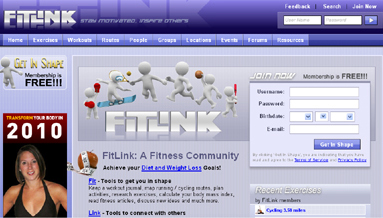
One of the important things about fitness, is a support network, i.e. strength in number leads to support, encouragement and common goals. With FitLink, it meets all of those criteria and more. I love the interface here and the site gets a lot of traffic and participation.

Sparkpeople can you say busy?

I like the niche-ness of Extrapounds

I love how clean this interface is at Wellsphere

FitClick‘s Social Fitness tool helps you to design a diet plan and workout, and you can also track your progress. Sort of SOP for a lot of social fitness sites. Tho I have a big problem with the skyscraper and banner ads pimping Jillian Michaels.

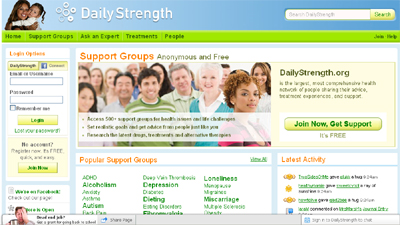
I like this next site for a few reasons, not the least being that the it’s about support groups. I have said for quite some time now that eventually social media will become more about specific niche’s than it will be about melting pots and this site Daily Strength is about groups and communities. I know it’s not specific to Health and Fitness, but allow me this free pass.

This next site My Fit Tribe has so much potential but is lacking in someone keeping it updated and current, but I love the design and the premise.

This site from Fitness Magazine might be the coolest. It’s somewhat of a narrow niche, but wow, create your own video workout? Was looking for an iphone app for it though, because what better way to utilize this than to take it to the gym with you? One complaint, page utilization is not good. You’ll see why.

Sometimes we have so much information and content, we feel that we have to give it all to the user. We want to show them how much we have and what we can do, what ends up happening though is that we end up vomiting the information on to the page. That what happened to MapMyRun. Hey remember what the name of your site is? Maybe that’s all you need to do?

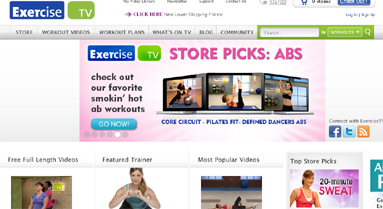
This site has all of the social elements it needs to be successful except for one.  I’ll let you see if you can guess. But nevertheless, Exercise TV has a clean UI with video, blog, community, Facebook, Twitter and iphone app  integration all working towards engaging the user at every touch point. But…Who or what are they missing out on?

One of the fastest growing companies on the Inc 5000 List and also one of the most visited health and fitness sites according to Compete. Lifescript would appear to have it all. Including the tacky ad placement in the top right hand corner. Other than that, I like this site.

What can I say about this last site? Livestrong has a great design and it hits on all the topics and issues that are front and center in people’s minds these days. It engages, challenges, interacts, revolves around community and it is totally wired socially.

In conclusion don’t forget that I said that these were my top 20 based on my criteria. Your criteria might be different and that’s fine. Most importantly is the fact that we, here in the United States, are an obese nation, and the more that we can use the sites to eat better and get in better shape, the better we all will be.

Social media is forcing us to operate in the now

We have our memories; and we all have a future that we look towards, but what we have right now is now. Social media provides us with, and allows us to provide, that real time data stream of what is happening now. Today. This moment, this hour, this minute.

We connect on various social networks with people who we have shared our lives with in the past. We connect with folks who we share common interests with in the work place, but it all happens in real time. We share our lives now with our family and friends as it unfolds. It’s immediate. We react, we create, we comment. In the moment.

These interactions are going to become more defined, more finite and more micro as we hurtle forward.

And I’m OK with that.