Is Being Too Social Ruining Social Media?


I was reading an article on MSNBC recently about Groupon and the tag line to the piece was the following:

“When everything’s social, nothing is.”

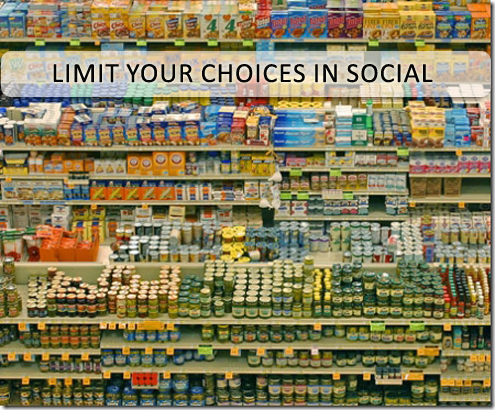
Which gave me pause to think.  What happens when you have so many options to do something or buy something or say something or share something in social? Is there a tipping point looming here where eventually everyone tires of being so social?

I actually think so.

It’s not going to happen yet, but as I was made aware in a comment on a post I wrote about social media bubbles-“there is a bubble, it’s just different”. So with that assumptive comment in hand, which in hindsight I now agree with. I think it is safe to say that eventually we as a social world will tire of being so social with each other. There’s just too many choices and it’s not decreasing anytime soon.

There will come a time where we just won’t want to share, chat, upload, download, friend, follow, or like from a social standpoint, a mobile standpoint, and a mobile social standpoint. It’s inevitable.  If we produce too much of something (i.e. social networks) then demand goes down right? We’re going to burn ourselves out. Let’s look at this another way.

Being social on the web is not a utility, but a lot of us use the social web from a utilitarian standpoint.  They are two distinct things. But when they start to bleed into each other, that requires more time, and for most of us, time is still a commodity.

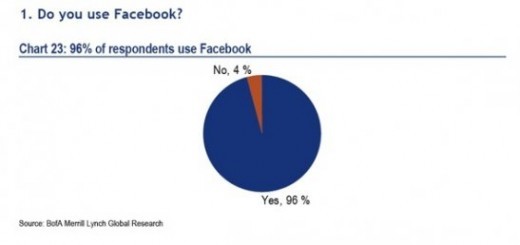
When social first came on the scene, the amount of networks were few and far between. Eventually more and more copycat type of networks emerged as the boom spread far and wide. The Big boys i.e. the Facebooks, the Youtubes, The Twitters and even the Myspace’s of the world enjoyed the rush. But as we head toward 800 million users on Facebook and we see stuff like this graph from Ken Burbary, we realize that we truly are in an age of “digital enamorment”.

Eventually there will be a correction where we pare down our networks and we start to refine who our connections are with, and what they stand for. Right now we’re too enamored with social to see that. As things progress we’ll soon realize that there is indeed a bit of truth to Dunbar’s number about limits to the number of people with whom one can maintain stable social relationships with. These are relationships in which an individual knows who each person is, and how each person relates to every other person. The number sits at 150 and ironically Dunbar did not figure online social networks into the mix.

Your goal? Develop and refine the networks you’re in and remember Facebook isn’t your network, it’s your platform. Who you are connected to within Facebook is your network.

The Voice of the Social Employee Inside the Firewall

In doing some recent research and “listening” to the voice of the customer lately on behalf of clients, it dawned on me that we really don’t talk much about the “voice of the employee”. Sure we talk about employee empowerment and internal ideation at some cool sexy companies that are doing “that”, but for most, the employee doesn’t get the type of play that it deserves. Up to now, we really haven’t given it an official name. For now on, I’m going to call it Voice of the “social” Employee.

For some organizations they will stress how important the employee is and then do nothing about it-call it lip service, while others actually put their money where their mouth is. However, if companies were all about their employees, why would 84%% of all employees in the workforce be looking for a job right in 2011?  Yes, part of that is attributed to an economy on the rebound but the other part of that equation has to be linked to factors such as genuine dissatisfaction.

For some of the dissatisfied, it just might not be a good fit and that happens, but what of the 84% who feel that the organization just  doesn’t care about them? How do you change that as a C level executive? Does any amount of internal collaborative software or initiatives bolster the morale of a disenfranchised employee? Can an internal socially powered ideation platform or network empower and propel an employee into massive production and an upbeat morale?

Does social media offer the panacea to an employee who feels that he is not being paid what he is worth?  Does social give a voice to the employee who isn’t happy? Does social soften the feelings of the employee who thinks that the company doesn’t care about them? Depends on whether they choose to voice that attitude in front of or behind the firewall. Right? In general, dissatisfaction voiced in front of the firewall results in a quick exit strategy-which is where most of today’s “social employees” reside.

Social media can do a lot of things especially in the worlds of awareness, HR, sales, marketing, PR and communication but it may not help when it comes to the employee who feels that they are not getting anywhere.  Consider the following three very general examples:

  • Sure, it’s great for sourcing new ideas but what happens when Betty in accounting can’t stand Fred in the cubicle next to her and Fred stalks her in all of her social networks both internally and externally? Does Betty complain openly on Facebook?
  • How does social enable Juan in shipping who busts his ass and yet no one notices because he’s so quiet and chooses not to use that hot new internal platform? How can a company leverage that through an internal social platform?
  • Roger in sales has devised a great way to save the company money but it involves using social media and might eliminate some positions-should he do it?

The voice of the employee is 10 times different than the voice of the customer. It’s layered in nuance, context and politics. You can’t serve the voice of the customer until you address the voice of the employee first.

We want our employees to be more social internally and to create bonds and ties and networks-but employees need to see the value to them and not necessarily to the company. There is the intrinsic value of participation for participation sake and of course there is the mandate of participation-but aren’t those basically disingenuous? What type of quality of participation can we actually expect?

One could say that the best way to motivate would be to incentivize.  And in a way Zynga struck a nerve when it realized that social network growth and app saturation could be wrapped around and tied to gaming-people like to be challenged, they like to be entertained and they like to be rewarded. Taken a step further if you were to look at Gowalla and Foursquare, and why they are/were successful-it’s based on the notion of a reward system-earning badges for “checking in”.

But I digress with this parting question. How can we empower, reward and engage our employees to higher levels using some of the basic success tenets of social media? We’re asking the backbone of our organizations to utilize social networks and tools to engage the customer and give the customer a voice but in the same breath we may be taking it away from our employees. We may be unknowingly muting and muzzling our employees for the sake of the customer and creating an opportunity for them to take “it” outside of the firewall.

The Distraction Economy

I admit I have some sort of Social Media ADD but it’s not my fault. I blame it on the emergence of multi-platform, multi-channel and multi-device access to me, to you and to them. There are too many places to find content, curate content, share content and consume content. There are too many places to have conversations, to read conversations and to lurk without having conversations.  I can’t scale and neither can you.

This has nothing to do with Dunbar’s number.  Dunbar was talking about relationships, I’m talking about the pull for your attention. It’s funny, but the reality is that it isn’t as much about me or you as  you might think it is. The desire to have you “In  Network”  is as much about YOU as it is about your personal data.  It might not even be predicated on your actual participation as much as you might think. But nevertheless, at the end of the day-Your presence, your bio, your participation, your video, your pic, your blog post, your quote, your tweet, your status update, your opinion, your recommendation, and or your location is what’s needed. Today. Right Now.

This isn’t the attention economy, this is the “Distraction Economy”.  You know I’m right, you just don’t have time to respond, but you’ll probably share this and maybe tweet it.

The Problem with the Social Web

Competition is a good thing. Burger King is across the street from McDonalds. Chipotle sits a few hundred yards from Moe’s, Sprint and AT&T offer virtually the same thing. At the end of the day it’s about choice and personal preference that decide whether we go for the hamburger or the hamburger, the buritto or the buritto, or the phone or the phone. Sure we might get a recommendation or suggestion from someone, or we might be motivated by some type of incentive-but ultimately, you make the choice to choose…

Two years ago my friend Jason Breed and I created Hashtag Socialmedia– a tweetchat that revolved around talking about the business of social media. We patterned the chat around the rise of tweetchats that had distinct hashtags associated with them-our model came from Sarah Evans and her #journchat, which at the time was virtually the only tweetchat out there.

Her idea became our idea. But with additional bells and whistles and a different topic. The same but different. What drove both were the variety and types of people that participated. Was it a form of “Me-too”-ism? Maybe. But we weren’t competing for the same eyeballs and ears, so it didn’t matter. We took the basic concept of a tweetchat and made it our own.

In the larger picture of the social web though-there is Facebook, Twitter, Linkedin, YouTube and blogs. Those are your so called starting points in social and then everything else sorta falls into lockstep behind them. I’m generalizing blogs, but if you insist, I could go with WordPress, Typepad and Blogger.

The point is this.  Right now we are stuck in the Me too phase of social. I see things being created that are offshoots of the basic premise of connecting, sharing and communicating-but nothing that is transformational. Nothing that is altering the way people do business.

If anything, I still see the adoption of social media taking longer than I expected.

Consider the following statements:

“We have a blog, come read it and find out cool stuff about our company”

“Come join our community and learn more about us”

“We have a Twitter account, follow us we may say something insightful”

“Come see our Facebook page and fan/like us”

“View our Youtube videos and share them”

“Download out mobile app and receive valuable benefits”

“Register for our email newsletter and print coupons”

See what I mean? We’re all drinking from the same well. Doing what we’ve been told works.  We’re all in the same bathtub and the toys in the tub are the same one’s that were there last week, last month and last year. Any new additions to the tub will be the same “type” of bath toys that are currently available, but nothing really new that may spur me to take two baths in the same week!. I know, what a ridiculous analogy-but my point being that I’m afraid that we’re stuck right now and it might be awhile before we become “unstuck”.

Recently I read where, First it was AOL, then it was Microsoft, then it was Google and now it’s Facebook. I’d say that was pretty safe. But look how different each was from the previous NBT.

It’s safe to easily sit here and say that Facebook is “it” right now, but also with the aspect of Twitter, Linkedin and YouTube  being variants of a solid basic notion that Facebook understood early on which is this:

All of those above mentioned platforms all have a solid foundation of “ease of  sharing, creating, connecting and communicating” at their core. There is no mystery about that. Sure, we’re exploring different ways that those can be exploited-but nothing really different. It’s “Here’s what you do, here’s how they work, the rest is up to you”- Now go do it.

The mystery is in what’s next. We obsess on it. But I will say this- We don’t need another Facebook. We don’t need another Facebook competitor either. We just need a better experience-but right now I don’t know what it looks like or where it’s going to come from.

Neither do you.

Will Color be the NBT in social? Or will it fade?

Think fast!

Find someone. Take pictures together.
Party. Play date. Lunch?

Simultaneously use multiple iPhones and Androids to capture photos, videos, and conversations into a group album. There’s no attaching, uploading, or friending to do. Share together in a new, moving social network. Just look around.


You may have no idea what I’m talking about. yet. Color is a photo sharing/social network app  launched last week, and it was  not a quiet launch either. Mostly because of the massive funding ($41 million), and a complete lack of documentation about how people should actually use the app. Count me as one of those still somewhat in the dark…

I loaded it, opened it, saw that I must upload my pic, no other instructions after that. I messed with it for about 10 minutes. Closed it and thought-$41 million huh? Did someone leak Color too soon? Is bad buzz better than no buzz? Do they even care what we think? Why launch an app like that w/o even some cryptic, requisite instruction on how this is supposed to change out social being? I agree that mobile photo sharing is definitely a route worth pursuing, but I’m still sitting here wondering what the business application could possibly be.

But let’s dig. So if it’s mobile social photo sharing, then, for instance we could pull the photos of specific events all  into one bucket w/o a lot of the fat right? We can see what everyone is seeing from that event, from different perspectives and vantage points right? That’s kind of cool. I’ll keep playing with it but as of this writing, I have rose-colored glasses. 🙂

If this is supposed to be the “Next Facebook,” I’d say they have a long way to go. Which reminds me, how is Diaspora and it’s quest to being the NBT in social coming along?

There are no take backs in social media…


Originally I was going to write about how NFL players not playing this past Sunday were tweeting during the NFC championship game about  how Quarterback Jay Cutler seemed to NOT want to go back in the game because of a perceived injury to his knee, how he was not tough, how he was soft, how he lacked heart. Little did they know that he was actually hurt. They were reacting more to his body language, to what the camera showed us or by what was being said or not said during the telecast. Little did they know that thousands were reading what they were tweeting.

I was going to talk about how the players NOT PLAYING  tweeted things I’m sure in hindsight they wish they could have taken back about one of their peers. How they didn’t know the impact this was going to have. How Jay Cutler couldn’t even defend himself given that the game was going on. It was compounded by how quickly it became viral over the course of the next 24-48 hours. Some players retracted what they said through additional tweets AFTERWARDS but the fact of the matter was that the tweets are there to be seen, searched and read by thousands. FOREVER!

Well if this authority figure or this well known former or current player said it or thought it or tweeted it, it must be right? It must be true. Right???

Yep I was going to talk about how athletes should be careful of what they say about themselves or others especially on social networks. Until it happened to me. This is one of those valuable lessons that includes more than public figures. It’s about you and me and how we treat others. And I feel awful about it. Let me give you a quick background.

I joined a private group in Facebook. It was a fun irreverent group of like minded professionals initially talking about the stuff, the challeneges , and the issues we face every day. But the tone of the group slowly shifted or evolved into something I didn’t really recognize anymore. I felt somewhat uneasy about the change and actually thought about leaving the group prior to; but I still fired up the machine to see what was being talked about and to contribute.

What happened was I got caught up in the bashing of a colleague and peer who I have respect for. He wasn’t there to defend himself. He wasn’t part of the group. It wasn’t fair. It’s one thing to critique a blog post-Hey we all write crappy ones from time to time, but taking it down a notch was not fair. I didn’t defend him, I joined in and kicked him too! It was there for people to read and comment on what I said. Most didn’t notice but I did. It’s bothered me ever since.  I know better. Not just the fact that it was on a social network but this has to do with civility and respect.

Afterwards, a good friend who was there and who actually defended this person, took the time to point out to me that I was better than that. She was right. I just wish I had realized it before. Sure it was in a private Facebook group but I can’t take back what I did and naming names does me or this blog post no good, but there’s a valuable lesson here. It’s one in which I’ve told companies about and probably fuels a lot of their trepidation of social media engagement.

Once it’s out there, it’s out there for everyone to see. It’s in ink not pencil

Sometimes, the hardest lessons are the ones you have to experience first hand. The NFL players who tweeted about Jay Cutler probably wish they could take back what they said, and so do I. It’s not part of what I am about. I can do better. I apologize. Like I said, there are no take backs in social media.

The Implied Participation of Social Media

If you’re new to social media marketing, you might feel like you’re a little late to the game. In a sense, if you are new, you are a little late. However, fear not, there are some who have actually been slogging through social media so long without any discernible results that they might as well have started yesterday. What is the reality? There is not much of a difference between you and them.

Two questions come to mind however. Why in 2011 have some waited this long to do anything with social media? And why does mediocrity prevail for those marketers that have been doing it awhile? For the novice and the advanced user, the similarities abound. Both feel the world of social media is moving incredibly fast. Too fast it seems. It’s why the beginners have waited and it’s a great excuse for those marketers that have been coming up short.  In fact the excuses might look something like this: I won’t be able to keep up, there’s no time, why bother, why continue, it doesn’t work, our customers don’t use it, there is no point, what’s the point? Or gasp, you can’t measure it and there’s no ROI! The collective belief being that maybe, just maybe, social media is temporary.

In either camp you could almost say that you’re waiting for things to become so simplified that participation will be as implied as Google’s home page. Enter a word, click a button, get a result. Good luck with that.

Funny thing though, it really doesn’t matter what your background is in 2011. It’s implied that you’re either in a social network and or you know what to do once you’re in a social network. Wow, that’s terribly assumptive isn’t it?

In today’s Uber connected world it’s easy to be intimidated or influenced into participation in social media just based on the notion that a) Facebook has almost 600 million active users and you need to tap into that or b) Your customers are on Facebook and Twitter and you’re not. You feel you must be there. Whether kicking and scratching or willingly, you’re being pulled into the vortex of social media-whether you know what you’re doing or not.

Did you know that when you go to Google’s search page and type in, “How do I use…” that one of the first results that show up in the search drop down box is, “How do I use Twitter and Facebook?” Which means that the phenomena of social networks has definitely peaked our collective interest as marketers and yet we are still not quite sure how to us social to sell or market our stuff-What do we do? How do we use it? How does it work?

Unfortunately there is not enough room here to really answer the above questions at length, but those types of questions are still coming from two familiar groups of people. That’s right, the novices and the advanced users, and all groups in between. The queries are emanating just as much from the small business owner wearing the marketing hat as the CMO charged with managing the Fortune 100. Though the surface level questions still revolve pretty heavily around the how’s and the why’s-The deeper question still might be-Why is there still a big disconnect or gap in social media adoption in 2011?


You might not think there is a gap because you might be the atypical user both from a marketing perspective and a consumer level. In fact some of you might think that things are evolving at a pretty normal pace- and they are, for you; but there are still a lot of segments of our society and business world that are lagging behind in social media knowledge, usage, experience, and adoption. Why is that?

Culture and cultures.  All of your customers are wired differently. Not all of them are always sitting in front of computers tweeting, downloading coupons, friending brands and buying stuff through Groupon and Livingsocial. Thus the types of usage, consumers, and networks that abound are as diverse as the people that live in one square block in SoHo.. What makes us different makes us unique. What makes this world the way it is? Our personalities, our backgrounds, our heritage, our family, our tribes…Our cultures. Social media and social networks are no different, they are just online digital extensions of our offline lives and the spaces that we play and work in.  So why the difficulty in adoption and usage? It’s implied we know what we are doing and what they want. It is assumed we know how to market to “them” because we know how to use social. I say Ha!

Do you remember back in grade school in PE class when it was demanded/expected that everyone would participate in dodge ball or kickball? Was everyone capable of playing at the same level? Did everyone want to play or participate? Did everyone know the rules? In some cases kids were forced to play right? If the option was given to play or not to play, how many would have? Half?  Either the coaches and PE’s teachers assumed everyone knew how to play, didn’t care, or they focused on the one’s that knew how to play. Those that didn’t know how, were left to figure it out as they went. Sound familiar? Just think if they had taken the time to teach, and or learn what they had to work with from the kids in the class!

If we’re to look at today’s social networks, Facebook is THE implied or de facto platform for social media participation and yet, there is nothing that says you’re supposed to have a Fan page for your company or product on Facebook, or that you know what you are doing. But we all drop into the funnel anyway, like lemmings. And yet there’s nothing that says you automatically know how “to be” social with your customers on Facebook either; or that success is guaranteed on Facebook. And that’s part of the problem. Lack of knowledge. The other part is that technology is waiting for users to catch up and users are waiting for technology to slow down, thus a lot of times most marketers are flying blind when it comes to using social media to sell products. They revert back to traditional forms of marketing using social tools and platforms. One way messaging with frequency.

With that said, here are 4 resources to help keep you current in today’s ever changing social sphere.

  • All Facebook http://www.allfacebook.com    –The unofficial Facebook Blog
  • YourVersion http://www.yourversion.com  –YourVersion is a tool for delivering the latest news, blogs, tweets, and videos on content that matters to you, all in one place.
  • TechCrunch http://www.techcrunch.com  –TechCrunch is a real time site profiling startups, reviewing internet products and breaking tech news. I start and end my day with this site.
  • SmartBlog on Social Media http://www.smartblogs.com/socialmedia A blog that daily delivers best practices, case studies & insights on social media marketing. I read it every day.


Lastly, In order for social media marketing to truly evolve, participation needs to be more fluid, connectivity less assumptive, and value all inclusive. Until then, the usage and effect of social media in the marketing mix will only be surface level.


How do you Leverage your Personal Data on Facebook?

Sometimes it’s the little things that really can drive a point home. Take for example a small conversation I had-actually it was an exchange of about 2-3 tweets between myself and Adam Cohen of Rosetta that occurred late Friday afternoon. It started with this:

It is a good post in Adweek about how food marketers  are trying a new approach when it comes to winning followers on Facebook by using online coupons and incentives that grow in value as more consumers “like” a brand on Facebook.

It’s sort of a Groupon approach but with a twist.

My tweet back to Adam after reading it was that, “Isn’t that really why people/consumers- fan/friend/like a Co.? Hoping for what they might get on the backend? Not always but..” My point to Adam being that Facebook friending, following, or liking a brand is all predicated not necessarily on brand devotion and loyalty, but more on what might that person “get.”-In the form of an offer, a coupon, a special, some swag, some recognition, some money, a job etc. etc. The “whats in it for me syndrome…”

I’ll like you as long as you kick me some…

There’s nothing wrong with that except when marketers and thought leaders want to paint the consumer following the brand on Facebook as an “Uber brand loyalist”- as something more pure than what I have just mentioned. But leave it to Adam to add a layer of levity to this though:

Great point. A value exchange. One to one. His point, the value of the consumers data in exchange for what you have as a brand. A trust level and brand affinity developed through traditional channels which can now be taken online into Facebook where the relationship can be deepened and enhanced. My value for yours…

In actuality, it’s still a “what’s in it for me” yo type situation but you, the consumer, really have an advantage, you just don’t know it.

Your takeaway? Value what you have as a consumer( your data) and leverage it-understand how important your data is to the brands that you like. How could you leverage your affinity to the brands you like online? Who’s benefiting the most from the brands that you follow or like? Is it a one off for them? For you?

The Four Semi-Truths of Social Media

First some quick definitions:

The definition of Nebulous according to Dictionary.com is hazy, vague, indistinct, or confused

Shelf life is the recommendation of time that products can be stored, during which the defined quality of a specified proportion of the goods remains acceptable under expected (or specified) conditions of distribution, storage and display

Depreciation is an expense that reduces the value of an asset as a result of wear and tear, or age. Most assets lose their value over time and must be replaced once the end of their useful life is reached.

Obsolescence is the state of being which occurs when an object, service or practice is no longer wanted even though it may still be in good working order.
Now what if we applied these to the world of social media?

My friend Danny recently sold his Boston Whaler. It was a boat no more than 2 years old and it was in pristine condition. He lost $5,000 on the transaction. His take? The boat depreciated as soon as he bought it. It was cool when he first had it he said, but after awhile, once the “newness” of it had worn off-it then was just an old boat that took up space.

Semi-truth #1: Our infatuation with the next, new, shiny, thing in social media depreciates as soon as we realize that it’s just another engagement, aggregator, application, thingy requiring more time, increased effort, permission to access, another profile creation etc., etc. and yet at the end of the day, delivers not much more than all the others. It’s like Danny’s boat.

——————–

Mike, a friend and a CEO of a cool little boutique ad agency, used to use Twitter, but then claimed that it was too nebulous. (Note I quickly had to run and look up the word nebulous)

His agency has never been doing better, and yet just because he doesn’t use Twitter any longer, doesn’t mean that he doesn’t think it has value for him or his clients. To him, Twitter is what Twitter is- But the basic tenets of good business like customer service and doing the job right, go further for him than “some web app”  that takes up too much of his precious client time. fair enough.

Semi-truth #2: The majority of social media applications can indeed be nebulous and though they may have the best of intentions with a cool interface-at the end of the day, they remain nebulous at best with a typical “make money via advertising” as it’s business model, and a primary marketing approach that is dependent on social “coolness” and going viral. Great news! Whether you use social media or not is not going to determine your success in business.

——————–

Remember MySpace? I honestly can’t think of a better definition of social media obsolescence, though there are many to go around. Yes they have had “some UI issues”, but at one point they were THE social network that everyone was talking about. What happened? It still worked and yet people just didn’t or don’t want to use it anymore. The coolness wore off.

Semi-truth #3: What happened to MySpace can happen to any social network. At any point in time, if something better comes along, or if people just get bored with what you are offering, they will leave, and there is really nothing you can do to prevent that, even if it “ain’t broke.”

———————

Some of your social relationships are platform dependent and might not last as long as you think. What is the useful shelf life of a social media generated relationship? What is the sweet spot for a “social relationship” before it plummets into the trough of disillusionment? How long does it last? 6 months? 1 year? Think Dunbar.

Semi-truth #4: Similar to the the shelf life of social networks,  some relationships in social media, though timeless, can be generally shallow and only last as long as both continue to use the application that bridged the engagement in the first place. If one departs, in general the surface like relationship ends. Thus the shelf life of social relationships is inversely proportional to a) Depth of engagement  b) Type of platform and c) One got what one needed.

——————-

Isn’t it interesting how shelf life, obsolescence, depreciation and nebulous can be so closely linked and aligned to the world of social media? It’s partly what makes social media great on the one hand, and so maddening on the other. It moves at the speed of sound and yet it’s innate fickleness is determined primarily by it’s  makers and it’s users and not much else. Yes new technology may change behavior, but behavior can change or determine the path of technology.