
I appreciate everyones comments and was made aware of a post by Jermiah Owyang from Forrester in which he compiled a pretty comprehensive list of white label or private label social networking platforms. Maybe this will help clarify things. I was looking at a very specific group of social media platform providers and not necessarily open source social media platforms or ready made solutions such as Ning. However, this does not mean that I am discounting the other players in the social media platform landscape.I just think that we need to segment them a little bit better since each offers a different spn and offering.
Category Archives: Social Networks
25 Enterprise Social Media Platforms/Companies To Be Aware Of
Here is as comprehensive list of players in the space that I could compile. I selected them based on my own professional sense of what I thought was important in regards to what they brought to the table and for whom. Some are more platform based than others, but I thought all of them were very relevant to where we are as of today. They are not in any particular order:













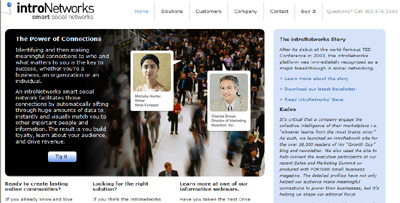
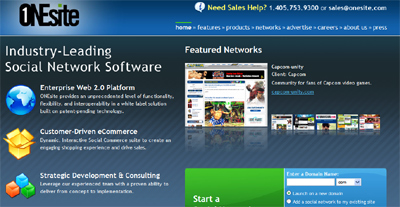
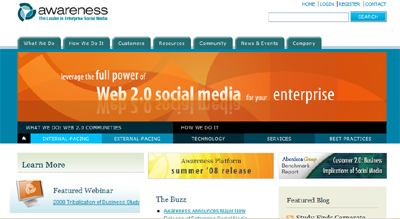


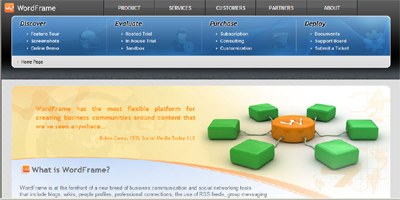


In conclusion, this list will expand and contract as conditions continue to evolve. Though some of the platforms/companies are not pure play, they all are contributing to the conversation, in what can only be construed as rhe dawning and evolution of a new digital phenomenon. Did I miss any in your opinion? What are your thoughts on the list? Are some better than others?
Why online communities fail
“What we’ve got here is…failure to communicate.” — spoken by “The Captain”, the imperious prison warden played by Strother Martin in the movie, “Cool Hand Luke”
We talk about how great social nets are and all of the great things it has to offer but here is the flip side to that coin, why do online social communities fail? Where is the disconnect? Here are some opinions on the matter from the blogosphere.
Here is a post in which Eric Zeman says that up to this point mobile social networking has been a big fat failure. I’ve blogged about this in the past and have basically said that the 2 issues that will slow this rush down will be lack of real estate on the hand held device and browser speed of course. What do you think? where do you fall?
Social networking 2008 Friend or Failure, did this guy get it right? To a degree he did. Of course we have this little ditty from the Wall Street Journal on why communities fail. which we did not really need to read to know why they fail. It’s the community people, its the people, people. It’s not the cash. People make communities work. If they didn’t, they wouldn’t call them communities.
John Furrier has an interesting take as well, in which he says that users want value not cheerleaders but that still doesn’t prevent him from saying that Social Media – Corporate Blogging – Most Failing? It has to be social.
Are you starting to see a trend here? As many supporters and champions of how great social nets are, there are still areas in which some if not many see shortcomings and potential for improvement in the model. Here are a few more. This one coming from the auto industry: Social Media Networks in the automotive industry are fledgling and the dynamics created inside of them is atypical of what you see in other niches.
Here’s a post from last summer, titled, Traditional marketing failing on social networks. Yes that still seems to be true though I am seeing some marketing gains in regards to companies putting the right people in place to handle new social media intiatives. But not at any acceptable levels.
What all of this is, is people looking at communities and saying they are failing, or they failed and then they start pointing fingers. Or they just count the reasons why they failed. Or maybe they are the ones, who have never participated? Bottom line should be, how do you prevent community failure in an online social network?
Here is a response from FreshNetworks in response to the Wall Street Journal article in which they are essentially saying, Branded online communities that are set up and managed correctly don’t fail. And I have to agree with them.
Here’s more on why online communities fail In a world saturated with solicitations where people have less and less attention available, most communities fail because they bypassed a few important questions, like “what are we offering users?”, “what is differentiating us from other communities?”,
And of course the online community numbers that don’t add up
Why do online communities fail? The biggest reason for failure is relying on technology – whether it’s websites, forums, Web 2.0, social media, social networks or any of the buzzwords. Too many businesses spend massive amounts of money on the technology rather than the plans and processes and people that are what make up a community. To a certain degree the technology might not fit but it’s technology that drives the process, so we have to rely on it.
The customer collective on why communities fail: The first reason is that many companies who embark on community initiatives are putting their company or product at the center of the effort. As many pointed out, that is obviously WRONG – you need to put the community member at the center and make sure that there is some passion around the initiative. Put the customer at the center, but the customer needs to know why they are there.
Three Reasons Branded Online Communities Fail Would you launch a new product or service line without an experienced person to develop and manage it? Not usually, no. The same goes for online communities.
Or perhaps, why online communities fail, Community is about community and community leaders, folks don’t be seduced by eye candy!
Why Does Corporate Social Networking Fail? Dave Allen weighs in at Social Media Today. And so does Jerry Bowles with Online Business Communities – Who’s Winning? Who’s Losing
In conclusion let’s remember the thing that people who have the cash to set these up seem to forget or overlook. It’s all about the community, the managers, the brand champions, the word of mouth people who love the site, the users who genuinely love to connect with people, it’s people who love the brand and the company, the people who would do anything for the company for the brand. Its the friendships made. Its about companies listening. Those are your community. NOT the marketers, and the tech people that built it. It’s the people that matter that contribute, and it’s the contributors that matter who matter most. What part of that do you not understand?
After reading your fair share, where do you think the burden of an online communities success should fall?
10 social media blog posts to read this week
Here’s a good midway point of the year article by Jim Tobin from Ignite Social Media on what the future of social media might bring. How many of these do you agree with? My 2 cents is that #4 will be more portable in regards to social media being more mobile rather than portable.
I haven’t had a chance to check these guys out Ecairn, but let me know if you do.
I’ve written about this in the past in regards to whether your online identity is alligned with your offline identity and Dan Thornton’s article takes it one step further. Check out his post, Is your online indentity in your control?
Richard at Dell has a nice compilation post from yesterday of things you should check out, not the least of which are The Blog Council, which I’m still on the fence with, and Feedly, which I have not checked out yet.
I love Mike Manuels’ post about measuring social media as well, since I sat in a bar last friday night and talked essentially about the same thing with Jason Breed from Neighborhood America. The bottom line and Mike’s post back it up. Very few companies have a clue about how to monitor their online engagements with social media as well as their online personas in general. You have to have a way to monitor your web traffic but then if and this is a big if, you are monitoring your social media interactions, what is the data that you are wanting to pull from it? What are your goals?
Read this post on Stowe Boyds blog, How we are made great and then lastly on Jason Falls blog, KatFrench has a great post on social media specialists chucking their backgrounds that basically asks the question, who’s running the ship for social media?
Social Media is not…Part II
As if having over 60 ideas, suggestions and observations of what “social media is not” was not enough, I now add an additional 25 responses from Linkedin and Twitter.
Social Media is Not
65. Your free answer generator if you run out of inspiration. After receiving this reply I responded that the person could do better than that and thus I received the following:
Social Media is not about individuals, it only is about its own gods and half gods. Since I am not a half god nor a god, it is quite obvious people would not know me. Social Media is also not definable since it is everything you want it to be and everything anyone else wants it to be. People who like to catch it in a few lines do not understand Social Media, since Social Media is more than some definitions and words alone it is a journey that never ends.
66. … A one way thing.
Be prepared for lots of criticism and people who have a lot of time and every motivation to make sure that what you are is accurate and true. If it is not… well we have all seen the examples.
Accept that any company/ product/ person that ventures into social media will be scrutinised and critisized.
While some shy away from social media for this reason exactly increasingly there is a realisation that abstaining is not a risk – free strategy. Getting out there and being honest might be scary but it certainly gains you a lot in terms of engagement and reputation.
67. … A substitute for a real social life.
68. …Doing much other than seriously turning everyone into a marketing expert to our global detriment.
When I mentioned that I would like to have him expound on this, and suggested perhaps he look at it differently, I received this heated response that diverts into a global political rant..
I’ll look at it as I please, thanks.
Anyone who tells me “you need to look at it like this” needs to look at, well, that kind of language and is a function of that culture.
The only reason I “need to look at it like this” is because your professional reputation depends upon the success of social networking. Otherwise what I said wouldn’t be such a threat to your well-being. None intended, but that’s what drives a statement like that.
True, social networking is not all bad, and they’re not all great either.
Where is all this communication getting us? It is a bourgeois pastime, a distraction from crippling debt, anti-intellectualism, fake dionesianism, and while on the surface, available to everyone for low-low rates, is yet another competition for time and energy towards things that really matter, like democracy and true personal freedom.
Our world is entering what appears to be an even greater period of vapid leadership than ever before. Why? Because MySpacers can’t see that Mr. Obama needs a team of 300 economic advisors. Bill Clinton could argumentatively engage that number in a blind-chess-tourney. All they see is a well-tailored marketing message.
Our present democratic contender is a direct result of the attitudes arising from social networking. He provides a message that is well tailored, yet inappropriate for our circumstance (he got prominence from unenlightened religious/political leader Oprah Winfrey, won the nomination on an anti-war platform, and having won it and being confronted with the economy, he’s got nothing. Nada. Zippo.)
We need a seriously deep, connected technocrat/intellectual to undo the ravages of this prior administration. This generation is going to continue to fail to see that all that glitters is not gold, and not all that’s being sold is worth buying. Unfortunately we’ll be worse off than with Hillary because they don’t know how to identify with what’s needed on a basis of principle over personality. And that’s the big, big problem.
At that point, I wished him well in his future endeavors!
69. The greatest thing since sliced bread, and it gets just as stale over the course of a few days. 🙂
70. The only internet marketing strategy.
71. An avenue to “push” your product.
72. A replacement for all marketing strategies and tools like ad, pr, print, tv, radio or other methods for a company.
73. Is not a replacement for good customer service or a good reliable product or product support.
74. Is not going to directly reflect $$ at the cash register in a short term– nor can it always be quantified in terms of dollars but actually name, brand, product recognition. Just as a tv ad might not reflect in significant sales, the social media should be dealt with in the same manner.
75. Is not static. It’s going to evolve so staying only on myspace.com isn’t the only place. There are other options that can employ social media within the context of the marketing strategy tools.
76. Is not just about the number of friends on whatever site you choose to be part of– you actually have to participate and you actually need to have a great product to deliver. It’s not just about the sizzle, you need to have the steak that goes with it. (as in show me the beef)
77. … Is _not_ a mass media
78. … Something you can do in your spare time.
79. …Addictive
80. … Going to make you any money this year. Or next year. Or the year after that. Or the year after that, or the year after that, or even *gasp* the year after that — unless you’re kin to Rupert Murdoch.
81. …A goal in and of itself.
82. …new.
It’s something you and your organization are already doing, only without applying the “social media” tag to it. It’s using <insert platform here> to make it easier for people to reach each other.
The concept is ancient both from conceptual and technological aspects. What’s new is the shiny implementations popping up… and actual mainstream acceptance. It’s now officially cool to be connected.
83. …Owned by marketing, nor PR, nor advertising.
84. …A destination, it’s a tool.
85. … Accurate and qualitative enough to trust.
86. …Is not a solution to every communication or PR problem
87. …Is not just for kids
88. …Is not a replacement for developing a solid strategy and should not stand alone as a tactic
89. …Is not a new way of thinking, it’s a new way of doing.
As you can see, the perceptions sometimes do not mix with reality. I engaged in some really lively discussions on this topic and will cause me to create an interesting slide presentation on the subject. I’m amazed as well at how skewed and actually how misinformed some of the respondents were. You can also see, where some are completely fed up with even talking about social media anymore. Their loss I suppose. In the end, as I was telling someone earlier, in a few years, we might not even recognize the monolith that is social media as it evolves into iterations that we haven’t even thought of yet.
26 people you could trust in the social media space.
In the second part of my series of trust in social media, I thought it might be a good thing to mention and highlite 26 people in the social media/marketing space whose thoughts I appreciate and whose knowledge and willingness to share that knowledge I value. I also thought it more important that it should be a list of people who would do their best to be a straight shooter, tell the truth, and give you what you need, not what they want you to have. Big Difference.
If I were you and you were either looking for that list of people whos blogs and companies that you could refer to on a daily basis or just starting out in trying to understand what social media is as it pertains to marketing, then this list is a good start. Not all of them swim in social media waters only, but it is still a very strong list for you to work off of.
- Scott Monty
- Stowe Boyd
- Chris Brogan
- Jeremiah Owyang
- Rohit Bhargava
- Charlene Li
- Phil Gomes
- Shel Israel
- Lee Odden
- Steve Rubel
- Valeria Maltoni
- Brian Solis
- B.L. Ochman
- Toby Bloomberg
- Drew McLellan
- MIke Sansone
- Seth Godin
- Geoff Livingston
- Maggie Fox
- Becky Carroll
- David Armano
- Joseph Jaffe
- Mack Collier
- Guy Kawasaki
- Gavin Heaton
- Rachel Happe
So who do you trust? Who’s words do you take to heart and try to apply to your businesses? Who motivates you to no end?
A creative proposal with a kick ass social media plan
Two agencies compete in a head-to-head pitch for a fictitious project based around the film “Casablanca.” live in front of several hundred people at iMedia’s Entertainment Marketing Summit
Doug Schumacher and his badass team at Basement, won the pitch. Here is the marketing strategy and creative thinking that won them the fictitious gig. Pay attention especially to the social media plan within the slides.
Here is the premise for the pitch:
“Shortly after winning the 1943 Academy Award for Best Picture, all the prints of ‘Casablanca’ were mysteriously lost. Although many stills, newspaper accounts, magazine articles and subsequent interviews with the stars of the film have long been available, nobody has seen ‘Casablanca’ since 1943.
“Then, in January 2008, an archivist stumbled across the prints in the Warner Bros. Burbank, Calif. lot. Excited by this discovery, Warner Bros. has chosen to do a limited theatrical re-release of this great but long-missing film.”
The mission:
The hypothetical re-release would be for Valentine’s Day weekend, 2009. The budget to work with was $350K-$500K for creative development and non-paid media, and $1,000,000 in paid media.
Here is the competitive landscape:
- A Matthew McConaughey/Kate Hudson romantic comedy opening on the same day and date
- A Michael Bay war-action-adventure flick, set in Iraq in a bit of counter-programming; same opening day and date
- A long-awaited two-part “More Sex and the City” is airing on TNT, part one on Valentine’s Day eve
Here are the slides:
Stupid corporate social networking site #312
This just in:
Cats Flocking to new social networking site!
In the category of “I have a great idea and I know management will go along with it”, we have the Purina Breeze cat litter social networking site. Courtesy of Marshall Kilpatrick over at ReadWriteWeb

Feel free to shoot me other examples of where Corporate America just did not get it right.
The definitive working list of what social media is not
I had, awhile back, compiled a list of what i thought social media was not. This morning while exchanging tweets, Beth Harte mentioned that Amber Naslund had just dropped a post on what social media isn’t, which led me to thinking: “why don’t we create a list of what social media is not”! There are so many lists and blog posts out there that are touting what it is, that maybe we should clarify and quantify what it is not. I would like this to be a continuous work in progress and need everyone to contribute as little or as much as possible. So here goes:
From Search Marketing Gurus we have the following:
- Social Media Isn’t: Easy
- Social Media Isn’t: Fast
- Social Media Isn’t: A Substitute for Sound SEO Practices
- Social Media Isn’t: A Substitute for Sound PPC Practices
- Social Media Isn’t: A Practice to be Done by Interns
- Social Media Isn’t: Another Place to Distribute Your Press Release
- Social Media Isn’t: Something That Will Work if Your Site is “Broken”
- Social Media Isn’t: Something To Send Out Mass Emails For
- Social Media Isn’t: Something You Can Do Without Participation
- Social Media Isn’t: Something You Can Do in Disguise
Courtesy of Rachel Happe we have: 11. Social media is not community
B.L. Ochman says that:
12. Social media isn’t a one-shot deal
13. Social media isn’t a technique
14. It’s not a short-term project
15. It’s not an experiment,
16. It’s not an event,
17. It’s not a quick fix. and
18. It’s not something you throw money at.
Brian Solis tells us that Social media is not:
19. The final frontier
Robert Young from GigaOm, mentioned 2 years ago that
20. Social Media is not Mass Media.
Is that still true? I think it’s not true any longer, nor might have never been. Its perhaps a function or channel of mass media though, or slowly becoming that.
John Gray writing for imediaconnection wrote that:
21. Social media is not just for kids, and I’m down with that!
Don Schindler from Media Sauce Blog tells us that:
22. Social media is not advertising or
23. It’s not marketing, it’s about connections.
Ike Piggot over at the Now is Gone blog mentions that,
24. Social media is not a commodity.
According to the Deal,
25. Social media is not the next bubble. But that was 3 years ago.
26. Social media is not a direct response marketing channel according to the 10e20 blog
27. Social Media may not be all that it’s cracked up to be, this from Jennifer Laycock over at searchengineguide. What the hell does “all that it’s cracked up to be” actually mean? I never really understood that statement.
28. Social media is not about Links, this from Li Evans
29. For teens, social media is not technology, it’s life!
30. Social media is not a free for all, thanks Luke Armour
Brian Magierski mentions that:
31. Social media is not just another marketing channel.
Laura Porto Stockwell believes that
32. Social media is not new
Thanks in part to Scoble we know that Social Media is not:
33. Newspapers
34. Magazines
35. Television
36. Radio
37. Books
38. CDs
39. DVDs
40. A box of photos
50. Physical, paper mail and catalogs and
51. Yellow Pages
And here are mine:
52. Social media is not up to them, it is up to you and your voice
53. Social media is not predicated on many to many
54. Social media is not one to one, but it can be.
55. Social media is not closed to anyone
56. Social media is not calm, sedate, unresponsive.
57. Social media is not passive
58. Social media is not laryngitis
59. Social media is not mainstream, yet
60. Social media is not static
And here are Amber Naslund’s:
61. Social media is not Show and Tell
62. Social media is not a Popularity and Numbers Contest
63. Social media is not a Silver Bulllet
64. Social media is not just for “Experts”
Ok so I think 64 is a pretty good start. What am I missing here? Feel free to add yours or, feel free to tell me where some of these might actually be wrong. Let’s talk about it!
LinkedIn in a nutshell
The folks from Common Craft have done it again. Here is a short video that demystifies LinkedIn.
 Direct Marketing Observations