Can anyone add some scalable and yet granular social networking, web 2.0 buzzwords to this bingo card to essentially bootstrap this into a viral marketing message?


Can anyone add some scalable and yet granular social networking, web 2.0 buzzwords to this bingo card to essentially bootstrap this into a viral marketing message?
Ok so I’m going to go out on a limb and here and say that chances are that most of the common masses do not know what a widget is. Even if you use your computer on a daily basis, there is still the slight chance that you might not know what a widget is. No big deal. Yet…
Simply put, a widget is a portable chunk of code that can be installed and executed within any separate web page by an end user( You or I) without requiring additional work or previous knowledge on the users part. Other terms used to describe widgets include: gadget, badge, module, capsule, snippet, mini and flake.
Widgets often but not always use DHTML, JavaScript, or Adobe Flash. A widget adds some content to that page that is not static. Generally widgets are third party originated, though they can be home made. They add a more rich, entertainment, multi-dimensional feel to a site that might be otherwise static.
Widgets are now becoming more commonplace and are used by bloggers, social network users, marketers, advertisers, and owners of personal web sites. They exist on home page sites such as iGoogle, Netvibes, Pageflakes, SpringWidgets and yourminis, and hundredes of other sites.
Widgets are used as a distribution method by ad networks such as Google’s AdSense, by media sites such as Flickr, by video sites such as YouTube and by hundreds of other organizations.
Applications can be integrated within a third party website by the placement of a small snippet of code. Which is now becoming a primary distribution or marketing channel for many companies. The code brings in ‘live’ content – advertisements, links, images, and video – from a third party site without the web site owner having to update.
Thus the end users can utilize widgets to enhance a number of web-based hosts, pages or drop targets. Categories of drop targets include social networks, blogs, wikis and personal homepages. Although end users primarily use widgets to enhance their personal web experiences, or the web experiences of visitors to their personal sites, corporations can potentially use widgets to improve their web sites using syndicated content and functionality from third party providers. They are also now using widgets as a carrier of their branding message or product.
So where can you find some widgets? The easiest source would be generally on the page you are currently reading, either on the left or right side of the pages. The widgets are dropped in via a widget managment system. Should you feel compelled, check out KickApps which states: The KickApps hosted, white-label platform puts social media and online video functionality directly into the hands of every web publisher who aspires to be a media mogul and turns every web designer and developer into a social media rockstar! With KickApps, it’s now easier than ever for web publishers to leverage the power of social and rich media experiences on their websites to drive audience growth and engagement.
If you are the casual reader, then hopefully this helps you. If you are a certified blogging fool, then this is nothing that you already don’t know. If you are somewhere in the middle, then now you have been enlightended.
Ok so much has been said about whether social networks are good for anything beyond poking someone and building a nice page that your six friends can check out, that I thought it would be interesting to see what the results would be if I had signed up for not 1 but 10 business oriented social networks.
Before I begin I need to set some specific goals though as to what I want to achieve. Do I want to meet potential business contacts? Sure I do. Do I want to help someone else get a project or a job or make a contact? Sounds like a good idea. Ok lets see what else? Drive traffic to the blog? Not a bad thing, but certainly not the end-all-be-all. Ok, so these are good starting points. However, I have no preconceived notions yet, but who does when someone signs up for one of these sights? What should be their expectations?
With that being said. I will have zero expectations but I will attack the 10 social networks with measurable goals so that we can see which has the biggest and quickest impact on me participating. The first thing on the experiment list is how intuitive are the sites? How easy was it to login and register? and What are they promising? Below is the list:
Coming up in the next post will be what the intial impressions were, how was the account creations process and a more descriptive explanation of each sites service offereings. Am I missing any sites that should be on this list? Has anyone had any experiences that they want to share?
Social networking is not just a US phenomenon. In fact, the United States, is not even the most wired country in the world. Hundreds of millions of people around the world are visiting social networking sites each month and many are doing so on a daily basis. Social networking is no longer a fad but rather an activity similar to checking your email daily.
While attracting global users, specific social networks have a tendency to skew in popularity in different regions. Take MySpace.com and Facebook.com for example, two-thirds of their respective audiences is from North America. But, both are poised and have already started to attract a more globally diverse audience. In fact Facebook has in the works, translated versions of its site.
Bebo.com appears to have a stranglehold on Europe currently, attracting nearly two-thirds of its visitors from that region, while Orkut is the social network of choice in Latin America (49 percent) and Asia-Pacific (43 percent). Friendster also attracts a significant proportion of its visitors (89 percent) from the Asia-Pacific region. Both Hi5.com and Tagged.com exhibit more balance in their respective visitor bases, drawing at least 8 percent from each of the five worldwide regions.
Check out these numbers thanks to comScore World Metrix

With the previous mentioned sites notwithstanding, here are the top 10 popular international networking sites:
XING-named openBC, claims that it is used by people from over 190 countries, albeit the majority of users are Germans.
Badoo–Based in London, Badoo is one of the top social networking sites in Europe
Passado-A European social networking site with strong audiences in France, Spain and Germany.
Studivz-A German version of Facebook with a strong audience in students.
Piczo-A social networking site aimed at teens with a strong following in Canada and the United Kingdom.
Orkut-Originally created by Google to compete with MySpace and Facebook, it has mainly caught hold in Brazil.
Migente-A social networking site targeted at Latin America.
Faceparty-A United Kingdom social networking site founded in 2000, it differs from the norm by charging a fee for features normally found for free in other social networking sites.
Cyworld-A South Korean social networking site similar to MySpace.
Bebo-Based in California, Bebo has gained popularity across the world, especially Ireland and the UK.
Can advertisers/marketers make money in a social networking environment? That is the real question.
Forrester reports about 30 percent of social networking site users embrace a brand so that they could become eligible for freebies,exclusive offers, events or sales or because another friend recommended it. Forrester gave this type of social consumer reaction as “friendonomics.” Granted it greatly helped the brand if they(the users) had some clue about what the brand was all about prior to befriending it, but it wasn’t a complete deal killer.
With that being said in regards to having a clue about the brand, Forrester states, Gen Y users “show the greatest interest, with 37% saying they would be interested in seeing marketer profiles on social networking sites. Gen X isn’t far behind, with 31% showing interest.”
What appears to work though and is gaining some traction, is the creation of widgets or apps on Facebook. If you use Facebook, you no doubt have noticed the plethora of new apps that have appeared over the past few months. These apps, created by marketers for instance, give some legs and visibility to brands, new products and sites that are looking for traffic and eyeballs.
Back in August of 2007, Google filed another patent for “user-distributed advertisements” (UDA) whereby the UDA system “facilitates insertion of manually selected ads into a document that is to be distributed (e.g., transmitted, published, and/or posted) such that the document is to be made available to other users.”
The document explains why it’s a good idea: “Although advertising systems such as AdWords and AdSense have proven to be very effective tools for advertisers to reach a receptive audience, even automated systems that use sophisticated targeting techniques often can’t match the effectiveness of manual targeting. However, manual targeting techniques don’t scale well. Therefore, it would be useful to provide a scaleable advertising system that achieves at least some of the benefits of manual targeting. It would also be useful to provide a system of charges and/or rewards to encourage useful manual targeting of ads. Further, it would also be useful to track and use performance metrics of such ads if doing so would help an advertising system serve ads that are more useful. Finally, it would be useful to provide data structures and interfaces for enabling advertisers to participate in a system for manual insertion of ads into a document for distribution.”
Long story short is that Google wants to figure out a way for its users to be worker Bees that essentially spread or carry advertising. What better way then to incentivize every possible action that someone does while online. So I send you an email and I go ahead and drop a couple of Adsense bombs in the body of the email and off you go to make us both money. All of a sudden it does pay to advetise via email again and the more viral the better!
The problem with trying to tie together advertising for instance, and social media is that to most and we’ll use direct response, is that DR advertisers, are going to look at specific measurable results which essentially will tell them if it’s a) worth it and b) should they test again. the problem with social networking sites and advertising, at least right now is that the results of advertisers are not yet quantifiable or measurable to a degree of their liking. There is too much grey area.
It’s grey because Social media is about engaging the prospect, befriending the prospect and winning the prospects trust instead of vomiting the information(makes for a great visual doesn’t it?) and the pitch, all over them. And if you don’t think is true, go ahead and try it and let us know what type of experience you have.
Essentially the whole social media experience as it pertains to direct response is more about marketing than it is about advertising. And to that end traditional online or offline advertising will not work in this environment anyways. So don’t bother.
Comscore released the November 2007 U.S. rankings of the top web widgets. For those of you who do not completely understand what a widget is, it’s essentially independent objects or an object that can be embedded or downloaded onto another site and can be used as a tool, have automatic content updates, or are or can be interactive. Though they go by the name of “widget”, Facebook calls them “applications” and Google calls them “gadgets.”
In November 2007, nearly 148 million U.S. Internet users viewed widgets, representing 81 percent of the total audience. MySpace.com widgets had the widest audience, reaching more than 57 million Internet users, while Slide.com ranked second with 39.2 million viewers. Google.com has the sixth widest widget-viewing audience with more than 19 million viewers.
What’s the “skinny” on what widget usage means to the lay person? Simply put, it means that widget usage can be computed as eyeballs on the site, which also means that if the widget is cool, you can bet others will go to get the widget. The widget is essentially another form of advertising. If they have your widget, that means they came to your site or heard of your widget from someone else. Word of mouth, Seth Godin, word of mouth!
Having said that, take a look at these November numbers.
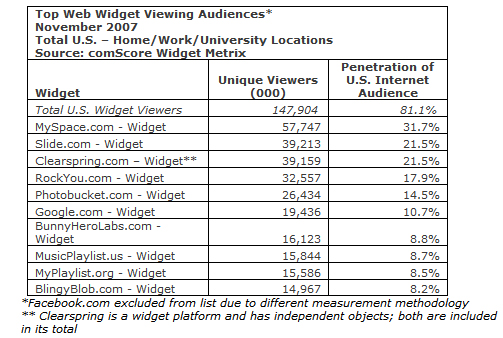
Obviously MySpace is the dominant player here but look at the others on the list. Slide for example is the largest personal media network in the world, reaching 144 million unique global viewers each month and more than 30 percent of the U.S. Internet audience. They help people express themselves and tell stories through personalized photos and videos created on Slide.com and viewed anywhere on the web or desktop.
Slide’s products — including Slideshows, FunWall and SuperPoke! — are popular on top social networking and blog platforms, including MySpace, Facebook, Bebo, Hi5, Friendster, Tagged and Blogger. Slide is also the leading developer on Facebook with more than 84 million applications installed and the most active users than any other developer.
Clearspring though is NOT a social network. Clearspring is the leading provider of cross-platform widget services. Their goal is to make it easy to use content and services from across the Internet to weave personalized experiences. Clearspring is the leading enterprise-class widget syndication platform. With our out-of-the-box syndication solution you can quickly repackage your existing content and services as viral widgets and syndicate them across multiple platforms.
RockYou is a leading provider of applications and widgets on the web. RockYou widgets include photo slideshows, glitter text, customized Facebook applications and voicemail accessories that are simple to use and enable people to frequently refresh their online style. RockYou has over 35 million users, serving over 180 million widget views per day in more than 200 countries. RockYou applications are customized for easy integration across all social networks including Facebook, MySpace, Bebo, Friendster, Tagged and hi5. RockYou’s cost-effective, results-focused advertising platform is the largest Ad Network on Facebook and the most dynamic method for rapidly acquiring Facebook application users. New applications can reach over 100k users in 24 hours, spanning a suite of applications across multiple publishing partners
Photobucket Owned by News Corp is the most popular site on the Internet for uploading, sharing, linking and finding photos, videos, and graphics. Photobucket, According to Comscore is:
The next one is BunnyHerolabs, bunnyhero pets bebo app the pets have been available on bebo for a while now as “widgets,” but now bunnyhero pets are available as an application on bebo’s new application platform.
What this means for bebo users is now when they adopt a pet on bebo, they can add the “bunnyhero pets” application. With the new application, they are able edit their pets after they’ve added them to their profile, like changing their pet’s name and color.
Next are the Musicplaylist.us and myplaylist.org widgets, which are a no brainer in the land of “can’t-miss” and “must-have”, widgets. And lastly if you ever wondered where all of the kitschy graphics on the MySpace pages was coming from, look no further than, and the name seems awfully apropos, BlingBlob.com. BlingyBlob.com, for us uninitiated, is the hottest source for FREE high quality graphics, animations, Flash and much more for your MySpace page, personal site, or blog. Makes you giddy, doesn’t it?
Look for music, video and image sharing widgets to continue to evolve to an extent that perhaps one day they become part of someone’s v-card or email signature, along with the location of their MySpace, FB or Linkedin pages.
By 2011 about half of U.S. online adults and 84% of online teens will be using social networks. This according to eMarketer. What this points to is an evolution or a continuing evolution of children who currently are becoming aquainted with and more comfortable with, “How social networks work”. This also points to the greater value that adults will put in their social network. “Their” being the operative word.
Furthermore, this raises a very poignant question. Though Facebook and Myspace are the darlings of the moment, can they continue the momentum that they can surely take credit for? Will they be “The” players in 3 years?
As it is right now today the evolution for most users looks something like this:
Club Penguin/Webkinz—->Myspace—->Facebook—-Linkedin.
I use Linkedin as the last one for professional reasons but really after Facebook, the usage fractures into a 100 different niche based social networks. This usage in the next 3 years will continue to evolve into hundreds of other social network sites.
My educated guess, though they (MySpace and FB) will still be viable, there will be others that will come along, if they have not already, that provide more to their niche than the current duo do. Here is the reasoning. Myspace is for teens/bands and tire-kickers and fringe users. Facebook is for college aged and older users who have more of a familiarity with the social network and all that it can provide.
So in 3 years when your current crop of Facebook users for instance, graduate and possibly outgrow the Facebook newness/coolness factor what do they do then? What do adults who are currently using Facebook do in 3 years? The same thing I suspect that AOL users did once they found out that AOL wasn’t the only game in town. Everything will evolve. Including the knowledge and expereince of the users. Thus the reason that by 2011, social networks will be so entertwined in our daily lives that it will be assumed that you are part of some SN.
The good news, and really none of this is bad news, but worldwide Ad spending will increase at a healthy 20-39% each year between now and 2011 according to eMarketer. In the U.S. alone social network ad spending is expected to rise to $2.7 billion in 2011. Currently the pie is being divided naturally towards Facebook and MySpace, but look for that to change significantly with the growth of niche and marketer oriented sites.
For December 2007, MySpace.com received 72 percent of U.S. visits among the social networking category. Facebook.com received 12.57 percent of visits and Bebo.com received 1.09 percent of visits. (according to Hitwise)
U.S. traffic to all the social networking websites increased four percent year-over-year. MyYearbook experienced the largest gain in market share in December 2007, increasing 407 percent compared to December of the previous year. Facebook and Club Penguin followed, increasing 51 and 48 percent, respectively. For those who are unaware of Club Penguin, it is the entry point for children into their first brush with social networks.
In December 2007, MySpace received 95 percent of its share of traffic from returning visitors. Among the top five social networking websites by market share, Facebook and BlackPlanet.com followed with 93 and 89 percent, respectively, of traffic returning from the previous month.
| Market Share of U.S. Internet Visits to Top 10 Social Networking Websites | |||||
|
Rank |
Name | Domain |
Dec-07 |
Dec-06 |
YoY % Change |
|
1 |
MySpace | http://www.myspace.com |
72.32% |
78.89% |
-8% |
|
2 |
http://www.facebook.com |
16.03% |
10.59% |
51% |
|
|
3 |
Bebo | http://www.bebo.com |
1.09% |
0.99% |
10% |
|
4 |
BlackPlanet.com | http://www.blackplanet.com |
1.04% |
0.96% |
8% |
|
5 |
Club Penguin | http://www.clubpenguin.com |
0.80% |
0.54% |
48% |
|
6 |
Gaiaonline.com | http://www.gaiaonline.com |
0.76% |
0.58% |
31% |
|
7 |
myYearbook | http://www.myyearbook.com |
0.73% |
0.14% |
407% |
|
8 |
hi5 | http://www.hi5.com |
0.63% |
0.64% |
-1% |
|
9 |
Classmates | http://www.classmates.com |
0.55% |
0.58% |
-7% |
|
10 |
Yahoo! 360 | 360.yahoo.com |
0.54% |
0.91% |
-40% |
I’ve preached for the past 6 months about how social networks need to become more focused in order for them to sustain any type of growth and visibility, let alone profits. It’s at this point that I must point you in the direction of a website called Disaboom. I’m going to quote from their site a bit so here goes:
 Direct Marketing Observations
