Sure I love the conversation but…

I used to be a social media purist but I’ve evolved. Why? Well we have evolved.  We being the one’s that were there early on who experienced the magic of connecting with someone as smart as  say Gavin Heaton or Tom Martin and having them host our social media tweetchat. Or having that cool, deep discussion with a person like David Alston from Radian 6 when his company was just starting to gain traction, or becoming really good friends with someone i respect as much as Beth Harte. But what made all of those discussions and conversations cool was that we were connecting. Great for us but what about B2B?

There was always the missing component. An outcome. A means to an end. The Why and the What for.

At least that’s what companies wanted to know. And still want to know. They wanted a better value proposition. Some get it but others are still struggling with this. Yea social media is cool but what’s it all mean? What’s the point? To have conversations or make money?  Give us a business use case.

Well yesterdays news of the Salesforce aquisition of Radian6 is a game changer. It’s a watershed moment.  I still like being a purist at heart when it comes to social media but we have to justify its usage. Quite honestly, We have been fighting the good fight for quite some time. Justifying it’s relevance. Educating the masses. But adding strong measuremaent and analytics to social media engagement as it pertains to customer service and sales and lead generation, does just that.  The folks at Sales Force believe that.

With this Salesforce/Radian6 deal, and Lithium grabbing ScoutLabs and MarketWire folding Sysomos into the mix, you are now seeing an alignment of B2B with social beyond just the conversation. Social will always live inside of marketing and PR, but tying it to business functions has now come to the forefront. And the way that become legitimate is by adding measuring and monitoring functions that are directly applied to making money, saving money, and building equity.

Like I said, Watershed moment…


Socially empowering your employees-What’s taking so long?


We talk and write about the ways to grow a business using social ALOT. Companies are obsessing over it. Even the really really big companies want to harness the promise of the prospect, the power of the existing customer and the potential of repeat business-All using social media.

Yesterday, I was talking to a manager of one of those really really big companies. We talked about empowering their employees to engage in outbound social media marketing- That’s a fancy sentence for basically letting your employees tweet and share things about the company on company time. The comment back was, “They are hourly employees, “We can’t do that-We can’t trust what they might say”…

That sentiment is not on an island.

Two days ago I was talking to a salaried employee of another large company who told me that they could not access Facebook from their work computers. Two thoughts came to mind. One-employees can use their mobile devices at any time to circumvent those rules and two, there is a lack of trust coupled with a fear factor of what that employee might do that is preventing this company from taming the social beast.

I mention the 2 scenarios because in both situations we’re talking about employees both salaried and hourly, in which trust is a huge issue.

How do you leverage the power of what your employees can do for you in social media in order to grow your company? Your customers would welcome the socially empowered employee representing your company. We are entering a time in which it is expected and in some cases demanded.

What is the exception and what is the rule? The rogue employee using social media or the empowered one representing all that is good about your company?

Social Media Conundrum #12: Justin Bieber is popular, but he’s not influential?

I can’t believe I’m going to weigh in on this, but I saw a tweet from a notable social media analytics consultant in which the following was stated for the umteenth time.

Popularity does not equal influence…

I immediately thought, “Could Justin Bieber and Lady Gaga sell product”? Isn’t that influence?I then had to go look up a quick definition of influence.

in·flu·ence

ˈɪnfluəns/ [in-floo-uhns] noun, verb, -enced, -enc·ing.

the capacity or power of persons or things to be a compelling force on or produce effects on the actions, behavior, opinions, etc., of others

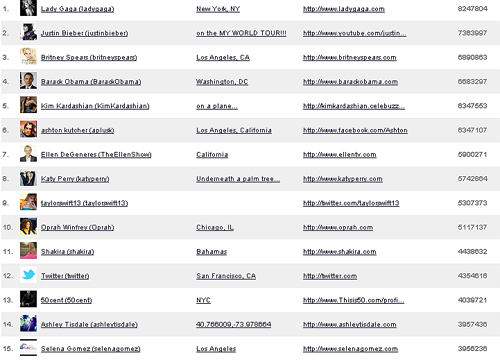
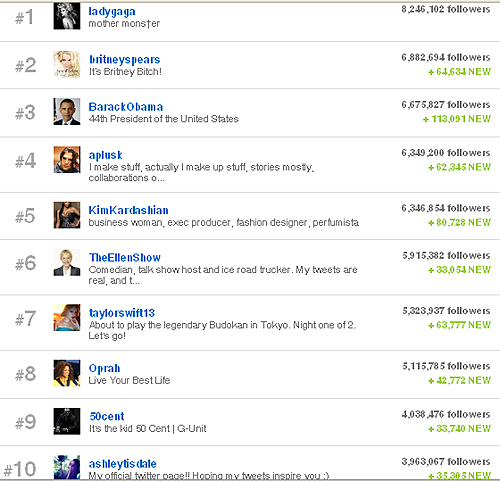
First I wanted to check something on Twitaholic: The top 15 people being followed on Twitter.

This is a list of the top 15 most “popular” people on Twitter. Let’s look and see who could sell or who does sell product. Let’s pare the list down first.

We have Justin Bieber, Lady Gaga, Britney Spears, Kim Kardashian, Ashton Kutcher, Ellen, Katy Perry, Taylor Swift, Oprah, 50Cent, Ashley Tisdale and Selena Gomez. 12 Celebrities from the world of entertainment. Immensely popular. But are they influential? Can they produce a compelling action on someone to buy product? Could they change behaviors and opinions? Can they influence people to buy stuff?

Lady Gaga sells video sunglasses for Polaroid, headphones for Beats by Dre, phones for VirginMobile, and a host of items and services via product placement in her videos. All this adds up to roughly $5-$10 million per year.

Rather than quote the whole  article from Guy Kawasaki, read about Guy’s experience at a Justin Bieber concert and the machine behind his persona.

Britney has deals with Elizabeth Arden and Candies. Taylor Swift has deals with Sony and CoverGirl. 50 Cent has deals with Reebok, Vitamin Water, Right Guard, PlayStation, and Steiner Sports.

We could easily go through each celebrity on this list and view the products that they sell. They sell the products because they can influence buyer behavior based on their celebrity, based on their popularity.  Am I wrong? I know sales are one thing and fame is fleeting, but because of their celebrity and popularity they can influence buyer behavior right now. Right?

How can you possibly say no? Isn’t that influence? What am I missing here? Help me out.


How Accountable are you with your Social Media?

Recently the spate of social media faux pas’s would tend to make one wonder if putting yourself “out there” is really worth it. The novice I’m sure is wondering that, as well as the expert. Why all of a sudden are people not caring or simply not thinking about what they tweet or what they say on a social network? This thought is what drove the following deck that I will be presenting this weekend in Orlando

The Implied Participation of Social Media

If you’re new to social media marketing, you might feel like you’re a little late to the game. In a sense, if you are new, you are a little late. However, fear not, there are some who have actually been slogging through social media so long without any discernible results that they might as well have started yesterday. What is the reality? There is not much of a difference between you and them.

Two questions come to mind however. Why in 2011 have some waited this long to do anything with social media? And why does mediocrity prevail for those marketers that have been doing it awhile? For the novice and the advanced user, the similarities abound. Both feel the world of social media is moving incredibly fast. Too fast it seems. It’s why the beginners have waited and it’s a great excuse for those marketers that have been coming up short.  In fact the excuses might look something like this: I won’t be able to keep up, there’s no time, why bother, why continue, it doesn’t work, our customers don’t use it, there is no point, what’s the point? Or gasp, you can’t measure it and there’s no ROI! The collective belief being that maybe, just maybe, social media is temporary.

In either camp you could almost say that you’re waiting for things to become so simplified that participation will be as implied as Google’s home page. Enter a word, click a button, get a result. Good luck with that.

Funny thing though, it really doesn’t matter what your background is in 2011. It’s implied that you’re either in a social network and or you know what to do once you’re in a social network. Wow, that’s terribly assumptive isn’t it?

In today’s Uber connected world it’s easy to be intimidated or influenced into participation in social media just based on the notion that a) Facebook has almost 600 million active users and you need to tap into that or b) Your customers are on Facebook and Twitter and you’re not. You feel you must be there. Whether kicking and scratching or willingly, you’re being pulled into the vortex of social media-whether you know what you’re doing or not.

Did you know that when you go to Google’s search page and type in, “How do I use…” that one of the first results that show up in the search drop down box is, “How do I use Twitter and Facebook?” Which means that the phenomena of social networks has definitely peaked our collective interest as marketers and yet we are still not quite sure how to us social to sell or market our stuff-What do we do? How do we use it? How does it work?

Unfortunately there is not enough room here to really answer the above questions at length, but those types of questions are still coming from two familiar groups of people. That’s right, the novices and the advanced users, and all groups in between. The queries are emanating just as much from the small business owner wearing the marketing hat as the CMO charged with managing the Fortune 100. Though the surface level questions still revolve pretty heavily around the how’s and the why’s-The deeper question still might be-Why is there still a big disconnect or gap in social media adoption in 2011?


You might not think there is a gap because you might be the atypical user both from a marketing perspective and a consumer level. In fact some of you might think that things are evolving at a pretty normal pace- and they are, for you; but there are still a lot of segments of our society and business world that are lagging behind in social media knowledge, usage, experience, and adoption. Why is that?

Culture and cultures.  All of your customers are wired differently. Not all of them are always sitting in front of computers tweeting, downloading coupons, friending brands and buying stuff through Groupon and Livingsocial. Thus the types of usage, consumers, and networks that abound are as diverse as the people that live in one square block in SoHo.. What makes us different makes us unique. What makes this world the way it is? Our personalities, our backgrounds, our heritage, our family, our tribes…Our cultures. Social media and social networks are no different, they are just online digital extensions of our offline lives and the spaces that we play and work in.  So why the difficulty in adoption and usage? It’s implied we know what we are doing and what they want. It is assumed we know how to market to “them” because we know how to use social. I say Ha!

Do you remember back in grade school in PE class when it was demanded/expected that everyone would participate in dodge ball or kickball? Was everyone capable of playing at the same level? Did everyone want to play or participate? Did everyone know the rules? In some cases kids were forced to play right? If the option was given to play or not to play, how many would have? Half?  Either the coaches and PE’s teachers assumed everyone knew how to play, didn’t care, or they focused on the one’s that knew how to play. Those that didn’t know how, were left to figure it out as they went. Sound familiar? Just think if they had taken the time to teach, and or learn what they had to work with from the kids in the class!

If we’re to look at today’s social networks, Facebook is THE implied or de facto platform for social media participation and yet, there is nothing that says you’re supposed to have a Fan page for your company or product on Facebook, or that you know what you are doing. But we all drop into the funnel anyway, like lemmings. And yet there’s nothing that says you automatically know how “to be” social with your customers on Facebook either; or that success is guaranteed on Facebook. And that’s part of the problem. Lack of knowledge. The other part is that technology is waiting for users to catch up and users are waiting for technology to slow down, thus a lot of times most marketers are flying blind when it comes to using social media to sell products. They revert back to traditional forms of marketing using social tools and platforms. One way messaging with frequency.

With that said, here are 4 resources to help keep you current in today’s ever changing social sphere.

  • All Facebook http://www.allfacebook.com    –The unofficial Facebook Blog
  • YourVersion http://www.yourversion.com  –YourVersion is a tool for delivering the latest news, blogs, tweets, and videos on content that matters to you, all in one place.
  • TechCrunch http://www.techcrunch.com  –TechCrunch is a real time site profiling startups, reviewing internet products and breaking tech news. I start and end my day with this site.
  • SmartBlog on Social Media http://www.smartblogs.com/socialmedia A blog that daily delivers best practices, case studies & insights on social media marketing. I read it every day.


Lastly, In order for social media marketing to truly evolve, participation needs to be more fluid, connectivity less assumptive, and value all inclusive. Until then, the usage and effect of social media in the marketing mix will only be surface level.

What Does Fully Engaged Mean?

Earlier this week, Ants Eye View posted The Cisco Social Media Listening Journey.

It was interesting to see Cisco’s evolution

But I was struck more with the final stage of the listening journey.

Food for thought. How fully engaged is your company? How fully engaged are your teams?

The propensity to Repeat in Social Media

It’s not just social media. Create a killer product, expect knock-offs. I used to say that you truly haven’t made it until you have been knocked off. It happens with consumer products, food products, you name it. Imitation is the best form of flattery right? Monopolies in social media? Facebook has an argument, but that’s about it. Everything else is fair game right now.

We’re a demand society. This is the “Consumers of Content” generation.

Networks, apps, aggregators, blogs, microblogs-copy what works, tweak it a little, or not, and see what market share you can pull. Make it just as good as… and release it. Make it better than…and release it. Because social media is “still” new and still growing, the thinking can be that there is always someone new coming to the party that may or may not be reading content for the first time, seeing a site for the first time and using an app for the first time. So everyone has a chance to succeed; but what seperates the real thing, the solid thing or the big dog from the one who just showed up trying to capitalize or catch the big wave? Sometimes money, sometimes nothing. It might just be an issue of WOM, Buzz or SEO and search.

In some cases the noobie or the one coming to the party late has a better chance to get it right. Take what they did and do it better, or just rip it off and call it something different. The noobie has a chance to appeal to the noobie.

From the standpoint of the blogger. How fresh can or could their content be? In social media, is it possible that what they are saying is fresh? Or is it just a fresh coat of paint, lipstick on a pig. Repeat the obvious and give it a fresh name and claim it as your own.

Why does history repeat itself even in social media? How many times can we read the 10 ways to use Twitter for your business? Because we will always be  suckers for bulleted lists. History shows that we love the compelling headline with the notion that what we might read is new, insightful and helps us leverage what we do in the social media. We’re hoping for fresh.

Who’s doing fresh in social media right now? What makes them fresh? What blogger is still a must read in social media? What are we looking for as readers these days in the world of social media? Is it all just about being sucked into another top 10? Can you resist reading a top ten?

Highlighting the Social-ness in Social Media this Holiday Season

A few weeks ago I was selected as one of the Top Social Media Strategists to Watch in 2011. That was cool in that it’s nice to be recognized, but then a few days later I got the following email.

We’re excited to have you on our list of “Top Social Media Strategists to Watch in 2011.” We admire your work and look forward to seeing what you come up with in 2011! Our partner, Dancing Deer Baking Co., would like to send you a sweet treat to congratulate you on our accomplishments. Please let me know where Dancing Deer should send the gift! Thanks.

I initially thought what a nice gesture and in normal times I would have taken them up on it, but these ain’t normal times. Upon further reflection, it seemed better to give that treat to someone who could really enjoy it this holiday season. Not that I didn’t want it, but isn’t the essence of social media as much about the realtionships and connections as it is about conversation? Sure it is. So here’s how I responded.

Hi Christina, Thank you but there’s no need to. Do me a favor and send my sweet treat to a homeless shelter or a boys and girls club-I’m sure they could, or someone could really enjoy it this week.

And then they responded:

Hi Marc,
 
Dancing Deer is a philanthropic brand at heart and donates to charities year round, especially during the holiday season. We’ll make sure that a donation is made on your behalf.
 
Happy Thanksgiving!
Cristina

So What Happened? I got this email.

Hi Marc,
 
I wanted to let you know that Dancing Deer made a donation on your behalf to the Pine Street Inn. Attached is a picture you can use for your post. We will post this to our social media channels this week. Thanks!
 
Cristina
 
Cristina Lepore, Marketing Coordinator

 451 Marketing, LLC
www.451marketing.com

Not only did Dancing Deer make a donation on my behalf but they brought a little more holiday cheer than just a “cupcake”. Here’s more about what they do from a philanthropic standpoint with a project called the sweet home project.  To me, this is what social media is all about, or at least what it’s capable of being. It went from someone recognizing someone for one thing, to a group of people realizing that there was more that could be done for others with the smallest of small gestures of human kindness. A cupcake. Thank you 451 Marketing and thank you Dancing Deer-You 2 are getting it right!

Makes you wonder what we could really do, doesn’t it?

The Takeaway from Social Media in 2010


Online privacy means a lot to us, but for a majority of us, it’s only important when we know our privacy has been invaded. In social networks and social media, every time we join a new shiny network, or register for something online, we give up a little piece of our privacy, like a sculptor chipping away at a piece of marble. Sometimes knowingly, sometimes not, we’re giving up who we are to marketers and brands.

You see, every time we create a profile we are allowing someone to glimpse a little bit more about us than most might really be comfortable with; but we do it because that’s what’s asked or required of us in order to “play”; and like I said, some of you might not even know it. Some of you might not care, because hey, “we’re living in the age of uber transparency”!

Yes we have a right to know what information is being gathered about us, how it is used and whether it is gathered at all, yet most of us are too busy trying to get on the other side of an app to be bothered with reading a EULA or a TOS agreement. Why is that?

I have a feeling  that the reason is similar to when you are hearing a radio spot and at the very end of the spot you’ll hear a guy talking so fast, you have no idea what he just said, so you ignore it, Because all you really care about is the deal that was mentioned in front of the fast talking man-The carrot, the offer, the opportunity. Privacy be damned. Most marketers and companies assume correctly that making the TOS’s and EULA’s so ridiculously convoluted, that we as consumers will just get tired of reading and will click the agree button. And the devil…is buried in the details.

Facebook did the same thing when it came to compromising our privacy the first time. How many times has it changed it’s privacy policy? Most of  the 500 million users probably don’t care what is happening to their data-and that’s a scary thought; but enough of them care to call Facebook out for assuming that we are ready to alter our perception of what is acceptable in data mining- and thus we’ve able to somewhat keep them in check.  I am still not comfortable about the purported data leaks, or satisfied that Facebook is doing all it can to value my privacy, but then again it’s a 1000 times better than it initially was.

So let me ask you something. As we head into 2011, are you cool with giving up snippets of your personal data for the sake of playing Farmville? Or being part of Groupon? or Foursquare?Are you comfortable with that? Are you truly prepared for radical transparency? I’m not sure I am just yet.