
Handcuffs chafe wireless users – USATODAY.com
To many, the Apple (AAPL) iPhone is the ultimate wireless device — a seductive blend of technology, function and dead-on cool, all wrapped into a sleek package.To others, it’s a glaring example of what’s wrong with the U.S. wireless industry in general.
“The iPhone offers superior technology, but public policies in this country allow (Apple) to chain that technology to one massive company, AT&T (T), rather than allow consumers to make the choices they want,” charges Josh Silver, co-founder of Free Press, a consumer advocacy group. His latest campaign — “Free the iPhone” — promotes an open Internet and consumer-friendly public policies for mobile devices. The website (www.freetheiphone.org) has resulted in “tens of thousands of supporting petitions,” he says.
Silver says his beef isn’t with the iPhone per se. Other U.S. carriers do the same thing with the devices they sell. But the iPhone, he says, “is a great example of how badly broken our media system is in this country.”
For starters, he notes, would-be iPhone users must sign a two-year contract, or contract extension, with AT&T, the sole U.S. distributor. Owners can access the Internet only via AT&T’s network, unless they happen to be in range of a Wi-Fi hot spot. And the iPhone works only with software sold by Apple and AT&T.
FIND MORE STORIES IN:Google | AT | Verizon Wireless | FCC | Nokia | Kevin Martin | Skype | Jim Cicconi
Though it is touted as a “global phone,” the iPhone is locked, so using it overseas requires paying extra for an international calling plan with — you guessed it — AT&T.
Such handcuffs are common in the U.S. wireless industry. Other big carriers, including Verizon Wireless and Sprint, impose similar restrictions, says Chris Murphy of Consumers Union. “Consumers have no bargaining power against these wireless terms that carriers can dictate. It’s a take-it-or-leave-it proposition.”
Murphy says carriers use a variety of tricks to keep wireless subscribers on a short leash, including:
•Restrictive service contracts. Most contracts bar customers from sideloading third-party software applications from their PCs onto wireless devices. Carriers rarely enforce that fine print, but they could, he says. Sideloading can also void the device’s warranty.
•Crippled phones. Some carriers disable handset features — such as free Wi-Fi capability — that compete with their fee-based services. Handset makers are at the mercy of carriers, so they strip out features as requested.
•Subsidized phones. Carriers use discounts on most new cellphones to justify requiring long-term contracts. Early termination fees can run $175 or more. Carriers say they need lengthy commitments to recoup their upfront costs.
•Locked phones. In the USA, most cellphones are sold “locked,” meaning a phone works only with the carrier that supplied it. If you switch carriers, you may have to just toss your handset — even if it’s an unsubsidized $599 iPhone — and buy a new one.
Asia, Europe have more options
The situation is different outside the USA. In Asia and Europe, cellphones are routinely sold unlocked, so consumers can buy any device and load it up with as many software applications as they desire. Each carrier provides an electronic “SIM card” which, when slipped into a phone, configures it for that network. Changing wireless carriers requires inserting a new card — not buying a new phone.
On the plus side, the U.S. system gives Americans super-cheap phones. Contracts help stabilize carrier revenue; that, in turn, helps keep monthly service prices cheap. On the downside, U.S. cellphones are not as feature-rich as phones in other parts of the world, says Muzib Khan, vice president of management and engineering for phone maker Samsung.
To keep costs low, manufacturers tend to “build to the lowest common denominator” for the U.S. market. That’s why there isn’t much variety here, he says. To blur the lack of features on U.S. devices, carriers tout ringtones, face plates and slim design — “things that one could say probably aren’t very useful,” Kahn says.
Because U.S. consumers pay so little for their phones, Khan says, they aren’t as “motivated” to learn how to use them properly. As a result, he says, they don’t get all the benefits.
“It’s an endless loop,” Samsung’s engineering chief says. “Until some changes are made, (U.S. consumers) will be in that loop forever.”
In other countries, consumers tend to pay full retail — $300 to $500 — for the handset, but they also get high-octane phones: DSL-fast Internet browsing, downloading and real-time media streaming, to name just a few features. High-resolution cameras are common. Ditto for Google mapping and touch-screens.
Bill Plummer, a vice president with Nokia (NOK), the world’s largest handset maker, says U.S. consumers are getting shortchanged. “American consumers have less choice in terms of the devices.”
Plummer adds: “They also have less choice in terms of services and applications they can take advantage of with these devices” — a nod to U.S. carriers’ tendency to block applications — such as Skype, a pioneer in Internet calling — that they don’t approve or sell.
Europe’s wireless free-for-all didn’t happen by accident. National governments issued edicts that effectively forced carriers to adopt consumer-friendly practices and a common technical standard (known as “GSM”). Consumers still have the option of subsidized phones by signing contracts — but it’s not a requirement for service.
FCC should step in, many say
The Federal Communications Commission, which has broad sway over telecommunications regulation in the USA, so far has taken a hands-off approach to wireless. That made sense 20 years ago when cellphones were a niche market. Now that they are ubiquitous, however, the FCC should step in, say applications companies such as Skype and other groups including Consumers Union.
FCC Chairman Kevin Martin demurs on whether more regulation is needed, but he admits to some frustrations. “Some innovative services are not becoming as available in the United States as they are abroad,” Martin says. “That is a trend I am concerned about.”
Take Wi-Fi. Martin says it could make faster mobile broadband mainstream — one reason it’s being deployed fast around the world. U.S. carriers, however, have been slow to roll out the technology, which competes with their pricier broadband offerings. Wi-Fi “appears to be stultified in its deployment here,” Martin says sternly.
To help address those issues, the FCC recently imposed an “open device” requirement on a choice chunk of broadband airwaves due to be auctioned off Jan. 16. This 700-megahertz spectrum is being vacated by TV broadcasters in their digital switchover. Signals in this range can penetrate walls and other obstacles, making them ideal for mobile broadband.
The upshot: Winning bidders will have to let customers use any wireless device and any applications they desire on the networks they build using these licenses. Expected bidders include AT&T, Verizon Wireless (VZ) and Google (GOOG).
The FCC’s initiative is the beginning of what could become a full-blown revolution for the U.S. wireless business, says Moe Tanabian, a principal with Interactive Broadband Consulting Group. “The business model of locking phones will fade,” he predicts.
The driver, he believes, will be U.S. consumers. Once they get a taste of freedom in the mobile broadband market, Tanabian thinks there’ll be no turning back. “Complete freedom in the wireless domain will happen, it’s just a matter of when,” he says.
“The carriers are going to have to change over the next five to six years,” Tanabian says. “If they don’t, they’re out.”
Less choice but lower rates
Jim Cicconi, an AT&T senior executive vice president, takes issue with the suggestion that Europe’s wireless market is friendlier to consumers. In the USA, service fees “are one-half to one-third cheaper.” Devices are also dirt cheap. Those who don’t want to sign a contract can always sign up for a “prepaid” plan, he adds.
“You don’t have to scratch your head a lot to figure out why the people prefer” the USA’s wireless model, Cicconi says.
Once a contract has been fulfilled, Cicconi says AT&T will “gladly unlock” a customer’s phone, if requested.
Plummer, the Nokia executive, says he can understand why U.S. carriers felt the need to control the customer experience in the early days of wireless. But not now.
“There was a point in time when we all needed training wheels for the fixed Internet,” Plummer says. “We left that behind well over a decade ago. Consumers should have a choice of device, a choice of network that they want to attach to and the right to pick the applications and content that they want to benefit from.”
Hoping to nudge that shift along, perhaps, Nokia now sells unlocked phones in its superstore in Chicago and is quickly expanding its unlocked line to independent retail outlets nationwide. (To use these phones, consumers must get a “SIM” card from every carrier they plan to use.)
Plummer says the move is a nod to the changing nature of wireless in general, and to the likely future of the business in the USA in particular.
“We think consumers should be able to make their own decisions” about devices and applications, he says flatly. “Nokia devices are developed for the global audience, and the U.S. consumer is a member of that global audience.”
Author Archives: marc meyer

Web metrics: Why you should run 2 analytics packages.
Did you know that not all analtyics packages are the same? If you think they are, you should pit them against each other on the same site. This way you can see for yourself, the way they look at traffic and the way they determine what is a unique, what is a hit etc etc..
Why? One of the most crucial aspects of owning and operating a website, is the ability to understand your traffic. Your users. Your lifeblood. If you don’t know the most basic of information coming from your site, how can you speak to doing what is best for your users or for your site? Thats where solid analytics of your site come into play. If you’re selling a product on your site, then it is even more important to know things such as unique visitors versus sales and what the conversion rate is. If your metrics are wrong or are off, then it can skew everything. Or should we say skewer?
Some good Free software packages are of course Urchin by Google and then a popular one, but one that costs a bit of coin, is Webtrends. Two others that we have had success with in house, and both which are free are Statcounter and Onestat.
One thing the free sites will not give you is a more detailed drilldown of your traffic. the reports also may be limited and also the type of data they return is sometimes light. But if you are strictly wanting to know uniques, then the free one’s should be fine.
Between the group we mentioned above, you should be able to play one against the other to see which one is giving you a more accurate accounting of your most prescious commodity. People.
This is just another piece of the puzzle that needs to be in place for a successful run in the online world.
Building a website? Don’t forget about the user!
In the golden age of SEO and SEM often websites are built with the search engines in mind. This is not necessarily a bad thing its just that sometimes one of the key elements is forgotten. The user. The person who brings revenue and eyeballs to your site in the first place.
We know that content is king, always has and always will be. We also know that content is one of the keys to a search engine friendly site. But when the content does not speak to the user and is geared more towards the SE’s. Then we have a problem. As a Search engine marketer, you have to be intrinsically aware of what you are trying to achieve. Simply put, you want…web nirvana. That happy place where you have achieved the goal of creating a search engine friendly site with a user friendly design.
It can be done, but remember that it has to be built from the inside out. That means your pages have to have ample room for content. Sure Flash is cool but really, what does flash do for a site? It makes it sexy and it’s visually appealing but the SE’s are not too wild about it. But… “What about my user? They like it!” And there my friend is the Catch-22. What’s good for the user is not necessarily good for the search engines. Thus the thinking that has to go into any and all web deployments. You have to straddle the beam like an olympian. Balancing between the users needs and expectations and the SE’s criteria.
Keep the flash to a minimum if you must use it, and spare the flash/splash as some organizations are wont to do. I would say that most users skip the intro anyway. Once you get past the flash, crank copy that you as a user would want to read and that is relevent to the site. After a rough draft, you can then go back and possibly tweak with some of your key words.
After you have crafted the content, then you can work on the structure, site maps, alt tags, metas and linking, all which speak to the SE’s and really won’t affect the user too much. Lastly once you have the site done, go back and see if it flows; and if you the user think the content is relevent to you, the user! While you’re at it, I would highly recommend one of the few Naples based seo companies
SEO: Actual rankings versus expectations
So the client comes in and says,”I need more traffic”. Ok you say, do you want the quick fix or do you want something that will last. In other words, are you willing to do the work that it will take to sustain a site that has traffic day in and day out or do you want to blow it out regardless of the cost? As a business owner, and depending on your product, your site and what you expect it to deliver to the bottom line there is reality and then there is the sweet smell of false traffic so to speak. I’m not saying that the traffic won’t convert to actual sales but when you run out of money acquiring traffic, then what are you going to do? So you’re sitting there saying, I have to or can spend money and I can generate traffic to my website. Absolutely. And you’re not the only one doing it. If you think the Big Players in your business of choice are not doing it, then you better think again. And they can outspend you right into the ground…
Some people think that once you build it and they come, they will keep coming back over and over and over again. That very well might be true if your brand is abercrombie, Gap, or Limited Two. But the online shopper is so fickle and so NET saavy anymore, that you really really have to work hard to keep that buyer coming back.
So having said that, your goal as business owner who has a web site, should be to acquire traffic, keep the traffic, sell to the traffic and keep them coming back. And the only way to really do that is to build your website right the first time. Granted you come back to the site and re-do it. We all do that. Or we tweak a page, upgrade this or maintain that. But I’m talking of SEO 101 where you build the site with the search engine’s in mind from the inside out, so to speak.
Some times we become so enamored of a design, a logo, a bell or a whistle that we forget the effect that the design will have on the design and how the SE’s( search engines) will view it. Make sure that whoever you are dealing with knows what they are doing in regards to a SE friendly design.
So to sum it up, if you think you are ranking well make sure you are looking at an organic or natural listing versus a paid one and understand that the paid listing is good only as long as you can afford to have it in the top 3 of the first page.
I could wax on, but I will save that for another post. The bottom line. Build your website right the first time so that the traffic keeps coming back. Oh and one last thing, make sure you have the right analytics tool to measure your traffic as well. For a company that is doing it right, you might want to check out my new venture, truly one of the few Naples search engine optimization companies
Typical search results page..
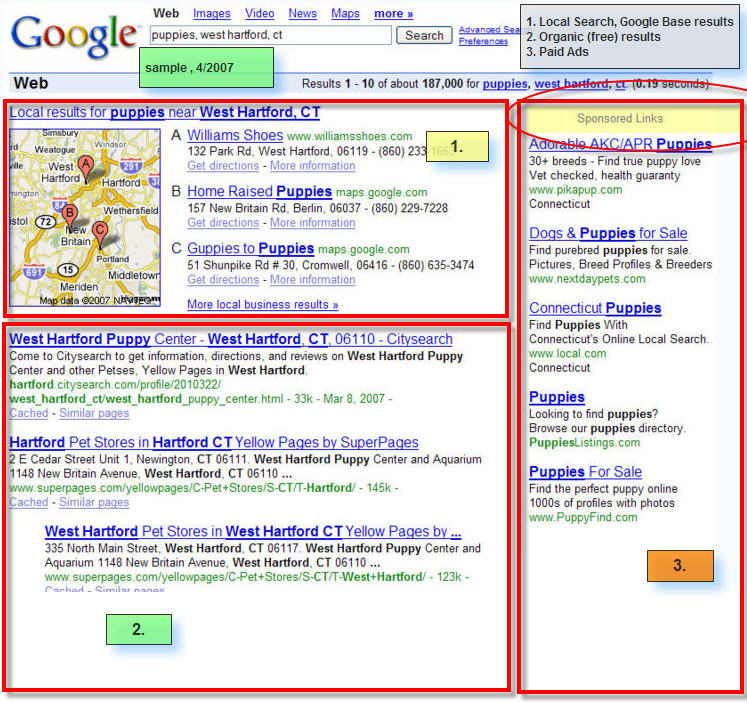 If you don’t understand, here is the down and dirty: Number 3 is paid listings. These are Googles’ bread and butter. Number 2 is the organic or “natural” listings. These are the tougher to get listings and the ones that mean the most if….you’re not trying to sell something. If you are trying to sell a product, then you need to be out there and in the top results of the terms that apply to the product you are trying to sell. If you can’t afford to be in the top 3 results for a paid term, then you need an SEO expert to get you in the top 3 natural listinigs. Number 1 are Google based local results. These are geo-based results and is the way that search is going, if it isn’t there already.
The Worst Logo EVER
Yes, this really is the official logo for Check Point security software. It was created by the CEO’s 6-year-old daughter. So much for the need for slick Ad agencies…
Worried about people ripping off your content?
Think it doesn’t happen? Plagiarism Search
Copyscape – Website Plagiarism Search – Web Site Content Copyright Protection
Search engine Algos’ change quicker than a stoplight.
As an SEO/SEM expert like me can attest, one of the first things we do in the morning is to check the natural rankings of all the sites they work on. Why? Because as much as they know what the the “Big Three”( For those uninitiated-Google, Yahoo and MSN) require, want and need for optimal organic rankings, they still are not quite sure where the respective sites that they’re working on, are going to end up ranked each morning.
Part of this can certainly be attributed to each SE marketers’s belief in what they do, is what is needed. But the other part is that because search is so ingrained in what we do and is so profitable to each of the SE’s, they, the SE’s, constantly tweak and adjust and change alltogether their Algo. They then look up out of the huddle to see what the other team is doing. Remember when you were a kid, or maybe you still are, and each team huddled up. Most huddled up, but some of us always looked up to maybe catch a glimpse of what the other team was getting ready to do?
The same thing goes on daily, hourly, weekly, in the SE wars. Why? Because search is so important in our daily lives and is so lucrative. Google is not the behemoth that they are because of all the tools they’ve rolled out over the last 3-4 years. It’s their core business of search. They do it well, they’ve done it best and they are completely branded and part of our culture. few have done it so well.
Think about like this. How many companies have become a verb. I.e. “I Googled Tim and found out that he is actually a multi-millionaire…. ”
I remember when Google launched and the first thing I thought was, a) what a cool name, and b) what a light and simple landing page. But that was the beauty of the user interface. Almost like walking into a club with a simple facade. Doesn’t seem like much until they let you in the front door, and as soon as you get in, you look around and say., “My goodness, I had no idea”. The same thing holds true with Google. Who Knew?
It used to be that Microsoft was the big dog on the block. Well for those living under a rock. It’s Google now. And because Google calls the shots in regards to Search they can also redefine the search algoritham, and by doing that, they force the other 2 to do the same. Do you see where I’m going. By changing or tweaking, they force the others to do the same.
It’s the essence of competition. In order to be the best, you can’t stand pat, you have to continue to prove why you are the best, you have to be different but you always have to do it better. You are always scruitinzed and you’re always held to a high standard and expectation. So far Google has done that, but it sure can be frustrating to the Naples Based Search engine marketers who are trying to figure out, just what are they doing over there in the huddle.


